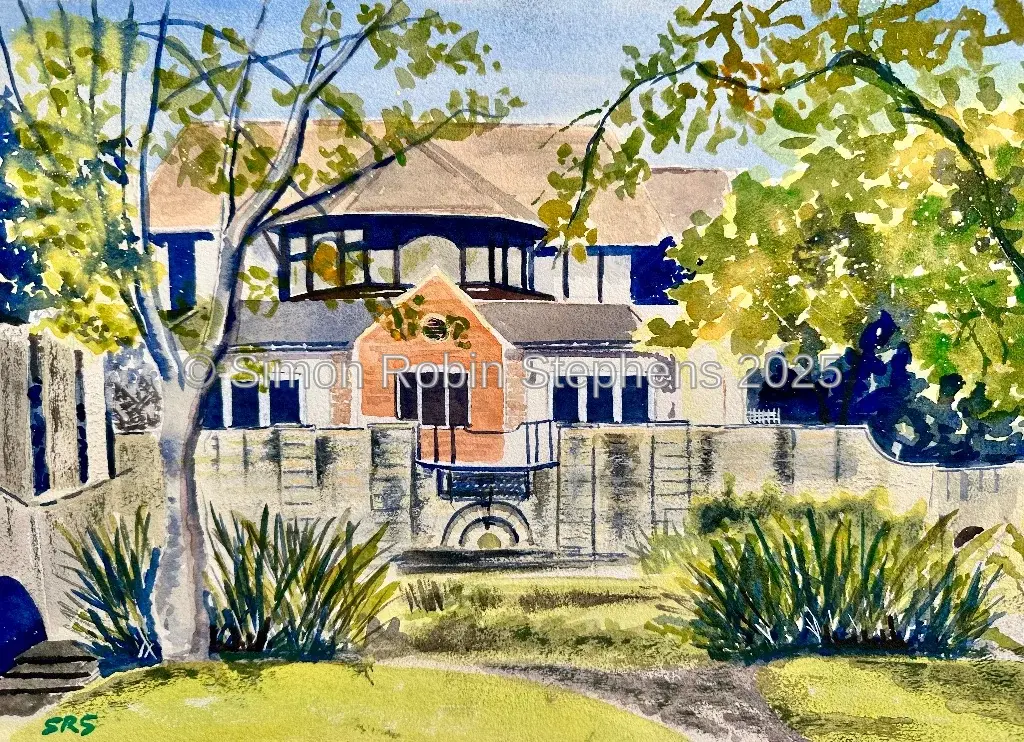
<p>Every painter has places they return to. The places that keep offering something new, or that keep asking to be looked at again, or that simply feel necessary. Mine are almost always near water.</p>
<p>The River Wandle runs through Carshalton, the South London village where I live. It is a chalk stream — one of the rarest freshwater habitats in England — and it has been running through this part of Surrey and South London for long enough that it appears in the Domesday Book. It powered mills along its length for centuries. It was heavily polluted through most of the twentieth century. And in the last thirty years, through significant conservation effort, it has been substantially restored.</p>
<p>I did not know any of that when I first started painting there. I went because the water was clear and the reflections were interesting and the light through the willows in the afternoon was doing something I wanted to try to paint. The history came later, and added something to the looking. But the looking came first.</p>
<h2>What Water Does to Light</h2>
<p>The reason painters return to water is almost always the light. Water changes what light does. It fragments it, multiplies it, inverts it. It introduces motion into what would otherwise be still. It creates the possibility of a painting that contains both the sky and the land simultaneously, one the original and one the reflection, the two versions slightly different in colour temperature and tone, separated by the flat surface of the water.</p>
<p>For watercolour specifically, painting water is an exercise in restraint. The instinct is to paint the reflections with the same care and detail as the things being reflected. But in most conditions, the water's surface simplifies rather than reproduces — it takes the complex visual information of a treeline or a bank of rushes and reduces it to a succession of broken horizontal marks, cooler in tone, slightly bluer, with the verticals compressed and the overall impression softer. Getting this right in watercolour — reproducing the quality of simplification without losing the sense of the specific place — is one of the technical problems I find most interesting.</p>
<h2>The Wandle in Different Seasons</h2>
<p>I have painted the Wandle in every season, at most times of day, in most weathers. The river in summer is generous — full of light, the overhanging willows dense and green, kingfishers visible if you sit quietly enough. In winter it is more austere, the trees reduced to their structure, the light low and lateral, the water carrying more sky because the banks are bare.</p>
<p>The most interesting light for painting is usually at the transitional moments: early morning before the sun is fully up, when the sky is pale and the shadows still long; late afternoon in autumn when the sun is low and the light has the particular warmth that only that angle produces. These are the moments when the Wandle's chalk-stream clarity becomes most visible — the water appears almost luminous, lit from below as well as above.</p>
<p>I have also painted the Wandle in rain, which is something I recommend to any landscape painter. Wet weather changes a landscape in ways that are difficult to understand from photographs. The colours saturate. The reflections multiply — every surface becomes a mirror. The sky is often more interesting on an overcast day than on a clear one, because cloud gives you gradation, directionality, drama. The physical challenge of painting in rain — wet paper, running washes, everything slightly out of control — turns out to be exactly the kind of productive constraint that improves decision-making.</p>
<h2>Carshalton Ponds</h2>
<p>The ponds at Carshalton are a short walk from where I work. They are the source of the Wandle — the points where the chalk aquifer beneath the North Downs emerges at the surface — and they have a stillness that the river downstream does not. The surface of a still pond in the early morning, before there is enough wind to roughen it, gives you almost perfect mirror reflections: the trees, the Victorian pump house, the overcast sky, all reproduced in the water with a slight deepening of tone.</p>
<p>It is a cliché that painters of all periods have been drawn to still water for its reflections, and clichés in painting are worth examining for the truth they contain. The reflected image has a formal rightness that a composition without reflection often lacks. It creates vertical symmetry. It doubles the colour. It introduces the possibility of near-perfect repetition with subtle variation — the same subject in two registers, one real and one apparition.</p>
<p>But beyond the formal qualities, there is something specifically calming about still water that I find difficult to explain without sounding romantic about it. The Carshalton Ponds in the early morning, when there is no one else there, have a quality of presence that I find clarifying for painting and for thinking. I have spent a significant number of hours simply sitting near them, not always painting, observing how the light moves.</p>
<h2>Water and the ADHD Brain</h2>
<p>I have ADHD. One of the characteristic difficulties of ADHD is executive function — the ability to initiate, sustain, and complete tasks that require sequential effort without immediate reward. Painting is full of these demands. Beginning a painting requires a decision about where to start. Sustaining it requires staying with something that is uncertain and potentially failing. Finishing it requires knowing when to stop.</p>
<p>I have found, over years of practice, that painting near water is genuinely helpful for these difficulties in ways that painting indoors is not. The sound of moving water — specifically the particular sound of the Wandle moving over chalk — is a low-level auditory stimulus that occupies a part of attention that would otherwise generate distraction. It is not silence, which can feel oppressive. It is consistent, non-verbal, patterned sound. For me, this is a form of cognitive support.</p>
<p>The visual interest of water also helps. The reflections are always doing something. The light on the surface is in constant, low-level motion. There is enough happening to hold the eyes, without the complexity that an urban environment introduces. I can look up from the painting and look at the river and return to the painting with my attention refreshed, which is a different experience from looking up in the studio and looking at a wall.</p>
<p>I suspect this is part of why so many people find being near water calming. The particular quality of attention it asks for — watchful, responsive, present but not effortful — is one that many people find restorative. It is not unique to those with ADHD or anxiety, though I think it may be specifically useful for nervous systems that struggle with the demands of concentrated, structured attention.</p>
<h2>What Water Teaches About Watercolour</h2>
<p>There is a useful analogy between the medium and the subject. Watercolour resists complete control in the same way that water does — it moves, it settles where it wants, it responds to forces that are not always under the painter's management. Attempting to paint a river with watercolour places you in a doubled relationship with the material: you are using a medium that shares the essential character of the subject. The best watercolour paintings of water are ones where the painter has stopped trying to describe the water and has instead collaborated with the medium — allowing the wash to do what washes do, the bloom to happen where it will, the wet edge to dissolve in the way wet edges dissolve.</p>
<p>This is a lesson the river teaches if you watch it long enough: that partial control is not a failure of control. It is the actual condition of working with a living system. The river does not follow a plan. Neither, ultimately, does the watercolour. The painter's job is to make something coherent and meaningful from what is available, not to impose a predetermined image on an unwilling surface.</p>
<p>I have been painting the Wandle for several years now and I am still finding new things in it. The light is never exactly the same. The water level changes with the season and the rainfall. The vegetation grows and is cut and grows again. There is always another morning with different conditions, another afternoon with a different quality of light on the chalk-stream bed. I expect to be painting there for a long time yet.</p>
<p>Several of my landscape paintings feature the River Wandle and Carshalton Ponds — you can browse them in the <a href="/gallery">gallery</a>. If the idea of painting from nature appeals to you, my <a href="/workshops">outdoor painting workshops</a> run through spring and summer along the Wandle in Carshalton.</p>