<h2>The ponds are older than the town that surrounds them</h2>
<p>Most people walk past Carshalton Ponds on their way to somewhere else. They're the first thing you see coming out of the station — a wide, glassy expanse of water flanked by willows, with the White Bear pub on one side and a car park on the other. Easy to overlook. Easy to treat as decoration.</p>
<p>But these ponds are extraordinary. They're fed by the River Wandle, which rises from chalk springs right here — water filtering up through the North Downs, cold and clear, entirely unaffected by rainfall. The ponds have sat in this hollow since before the town existed. Before the railway came. Before the roads. In a suburb of South London, you can stand on the bank and watch a kingfisher.</p>
<p>I've been painting them for three years. I come back every season because they're never the same.</p>
<h2>What the chalk water does to light</h2>
<p>Chalk-fed water has a particular quality. Because it comes from underground — filtered through hundreds of metres of chalk — it's consistently cold and consistently clear. In summer, when algae cloud the edges of most standing water, the main body of Carshalton Ponds stays translucent. You can see the bottom in places. The reflections are sharp-edged, almost architectural.</p>
<p>In winter, when the overcast English sky sits on everything like a grey lid, the ponds take on a pewter quality that I find almost impossibly beautiful. The water is dark but still lit from within — the chalk reflecting what little light there is from below. On a still morning in January, the reflection of the bare willows is so accurate you could hold the image upside down and not immediately know which way was up.</p>
<p>This is the quality I try to catch with paint. Not a photographic copy — but the sensation of standing there in the cold and feeling the light on the water as a weight in your chest.</p>
<h2>The wildlife that most people miss</h2>
<p>Because I come to paint and not to pass through, I stay longer than most visitors. And staying longer is how you see the ponds properly.</p>
<p>Kingfishers work the shallower eastern end of the lower pond — the stretch near the High Street, where the water is only knee-deep and the small fish are visible. I've seen them dozens of times now. They arrive like an announcement, a flash of iridescent blue-green that's too vivid for suburban South London, and then they're gone before you've properly registered what you saw.</p>
<p>There are herons. Grey herons that stand completely still in the shallows, apparently ignoring you until you get slightly too close and they lift into the air with a prehistoric groan. There are coots, moorhens, tufted ducks, the occasional goosander in winter. Last February I watched a cormorant spread its wings to dry on a post in the middle of the lower pond — a posture so heraldic it looked like someone had placed it deliberately.</p>
<p>All of this is five minutes from my studio. In South London.</p>
<h2>Why I paint the same place repeatedly</h2>
<p>There's a tradition in landscape painting — Constable did it, Monet did it — of returning to the same place across seasons and weather conditions. The subject isn't the place: it's the light, which is always different. The place is just the stable framework that lets you notice the difference.</p>
<p>Carshalton Ponds is my Haystacks. Or my River Thames at Goring. Something I know so well that I can paint it from memory and still be surprised by what I've remembered.</p>
<p>For me, the repetition also has a therapeutic function. My ADHD means that new environments demand enormous cognitive effort — cataloguing, assessing, orienting. A familiar place reduces that overhead. I arrive at the ponds and my brain already knows where the light tends to come from, where the reflections are most interesting, where to position myself for the angle I want. I can get straight to looking.</p>
<p>There's something almost meditative about it. Not blank meditation — not emptying the mind — but the focused, absorbing attention that happens when you're trying to see something accurately. The ponds give me somewhere to put that attention every time.</p>
<h2>The paintings that have come from this place</h2>
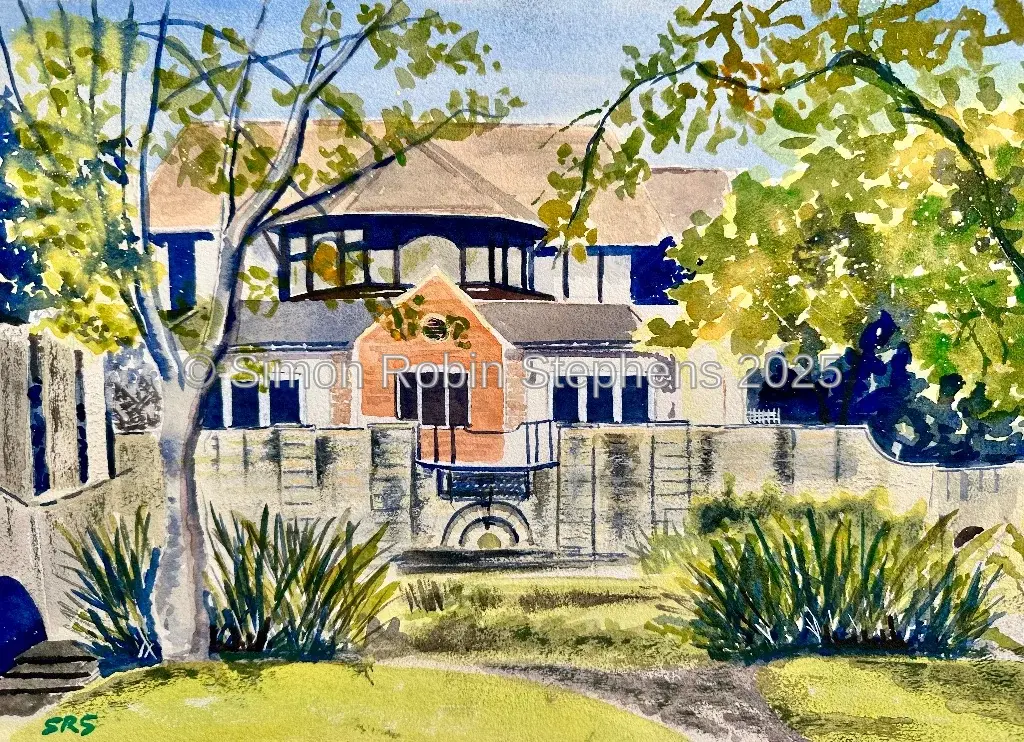
<p>I've completed more than a dozen watercolours of Carshalton Ponds. They range from small, rapid studies done standing at the water's edge — A5, painted in under an hour, capturing a specific quality of light before it changes — to larger, more considered works back in the studio, where I try to distil a whole season into a single image.</p>
<p>The ones I return to most are the winter pieces. There's a painting I made in January 2025 of the upper pond just after sunrise, before any other walkers had arrived, when the mist was still on the water and the willows on the far bank were just visible through it. The colour palette is almost monochrome — warm greys, muted browns, a single note of amber where the weak light was catching the old boat shed. I've looked at that painting many times and it still gives me the feeling of standing there.</p>
<p>That's the measure I use for whether a painting has worked: whether it gives you the feeling of the place, not just the appearance of it.</p>
<h2>Commission a painting of a place that matters to you</h2>
<p>I'm available for commissions of specific locations that have meaning for you — your garden, a view from a house you grew up in, a stretch of river or coast, a park where something significant happened.</p>
<p>Carshalton Ponds means something specific to me. But every place means something specific to someone. If you have a place like that — one you want to hold onto — I'd like to hear about it.</p>
<p>Commissions start from £180 for a small original watercolour. The process: you tell me about the place, send reference photographs if you have them, we agree on the approach, and I paint it. You have final approval before any payment is made in full.</p>
<p><a href="/commission">Start a commission enquiry →</a></p>
<h2>Coming to paint in Carshalton</h2>
<p>If you want to paint the ponds yourself — or paint the surrounding streets, the Ecology Centre, the All Saints Church reflected in the water — my workshops give you a structured introduction to landscape watercolour in an environment that's genuinely beautiful.</p>
<p>The Surrey Landscapes session on Saturday 7 June 2026 focuses on exactly this kind of subject: sky, water, reflection, the quiet tonal range of a northern European landscape. Maximum 12 participants. All materials included. £45 per person.</p>
<p><a href="/workshops">See all upcoming workshops and reserve your place →</a></p>