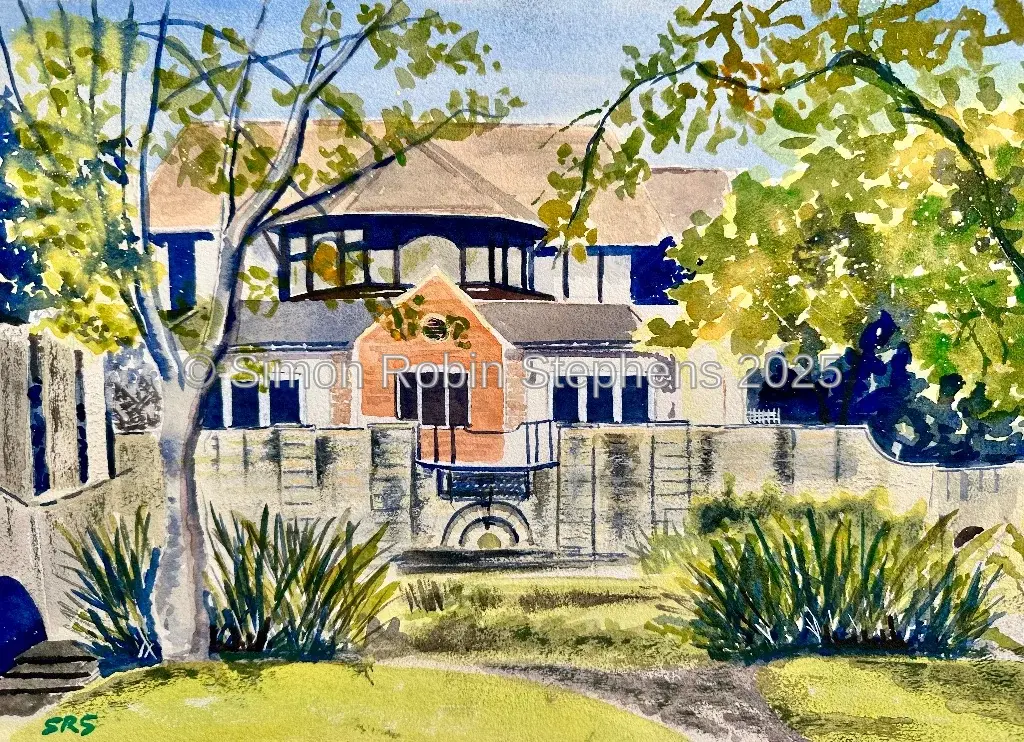
<p>There is a moment, specific to plein air painting, that does not exist in the studio. You are standing in a field, or beside a lake, or on a path with the wind coming in over open ground, and the light is doing something that will last exactly twelve minutes before the cloud moves. You have to decide what the painting is, commit to the mark, and go. There is no pausing, no reorganising, no returning to it tomorrow. The field and the light and the twelve minutes are all you have.</p>
<p>Studio painting is not better or worse than this. It is categorically different. And understanding what each mode asks of you — and what each gives you — has been one of the more useful things I have learned in my practice.</p>
<h2>What Plein Air Forces You to Do</h2>
<p>Painting outdoors is a curriculum. Not a comfortable one. The first thing it teaches — and keeps teaching, because it is a lesson that does not stay learned — is decisiveness.</p>
<p>In the studio, you can always do another layer tomorrow. You can cover a mistake with another wash. You can change the composition by masking out a section and reworking. The studio offers revision as a permanent option, and revision is very easy to confuse with progress.</p>
<p>Outdoors, revision in this sense is impossible. The light has moved. The subject has shifted — a cloud has filled in what was a dramatic shadow; the wind is bending the tree the other way; the tide has come in and submerged the foreground rocks. The painting you are revising is of a scene that no longer exists. So you stop revising. You make a decision and you live with it.</p>
<p>This is — there is no softer way to put this — terrifying, for a while. Then it becomes clarifying. Then it becomes one of the things you most value about the practice.</p>
<h2>What Plein Air Teaches About Observation</h2>
<p>The second thing outdoor painting teaches is looking. Not glancing, not photographing-then-looking, but the specific quality of sustained visual attention that is available only when you are standing in front of a subject that is doing its own thing regardless of whether you are ready.</p>
<p>In the studio, you work from reference — photographs, sketches, memory. All of these have been processed and filtered. A photograph has already made decisions about contrast, saturation, depth of field. A sketch has already selected what mattered. Memory has already edited. When you work from these sources, you are painting your interpretation of an interpretation.</p>
<p>When you stand in front of the actual subject, you are receiving information that has not been filtered. The colour of that shadow — which your photograph rendered as a solid brown — is actually made of three different blues and a violet, visible only in the original light. The tree's edge against the sky — which your sketch simplified to a single curved line — is actually a thousand interruptions, each one slightly different. The painting you make from direct observation will contain information that no photograph or sketch would have given you.</p>
<p>This is what painters mean when they talk about painting from life. It is not a purity claim or a rejection of modern technology. It is a description of what the direct encounter gives you that mediated sources cannot.</p>
<h2>The Specific Energy of Plein Air Work</h2>
<p>Paintings made outdoors have a quality that I can recognise in the work of other painters and in my own: an urgency, a directness, a willingness to leave things unresolved that studio work sometimes lacks. Some of this is technical — the marks made quickly and decisively look different from marks made carefully and deliberately. But some of it is something harder to pin down, a quality of presence that seems to be readable in the work itself.</p>
<p>I do not think this quality is universal. Some plein air paintings are stiff and laboured — the painter fought the time constraint rather than working with it. Some studio paintings are luminous and alive — the painter brought their outdoor experience to bear on a measured, considered process. But on average, in my experience, outdoor work has an energy that my studio work has to consciously try to recover.</p>
<h2>What the Studio Gives You</h2>
<p>The studio is where the painting becomes what it is trying to be. The plein air sketch — often made in forty minutes, on A3 paper, on a windy hillside — is a record and a starting point. It contains the essential information: the tonal structure, the key colour notes, the moment that was worth painting. But it is frequently unresolved, patchy, cut short by a change in light or the limits of what is possible standing at an easel in October.</p>
<p>The studio lets you work through the implications. If the sketch showed a light breaking through cloud onto a hillside, the studio is where you can consider what that light actually means compositionally — where it leads the eye, how it relates to the darker passages, whether the foreground needs to be lighter or darker to make it read. These are questions that require stillness and time, which the plein air context rarely provides.</p>
<p>The studio also allows for the kind of glazing — the layering of transparent washes to build depth and luminosity — that is technically very difficult to achieve outdoors. Glazing requires each layer to dry completely before the next is applied. In a studio, you can work on three or four paintings simultaneously, returning to each as the previous layer dries. Outdoors, you wait or you make a mess.</p>
<h2>The Dialogue Between Them</h2>
<p>The most productive relationship between plein air and studio painting is not a choice between them but a conversation. The outdoor work feeds the studio work with information, energy, and the essential quality of observed truth. The studio work develops the outdoor material into paintings that can carry sustained looking — work that rewards being lived with rather than being glanced at.</p>
<p>Some painters work exclusively plein air and find the constraints liberating rather than limiting. Some work exclusively in the studio, building their practice on photography and memory. Both are legitimate. But my own experience is that each practice without the other atrophies in a specific way: studio-only work can become timid and overworked; plein air-only work can become repetitive and unreflective.</p>
<p>The outdoor sessions teach me to look. The studio sessions teach me to think. I need both.</p>
<h2>Getting Started Outdoors</h2>
<p>If you have been painting in a studio or at a desk and want to try working outdoors, a few practical notes from someone who has made all the obvious mistakes.</p>
<p>Start with a very limited kit. You do not need an easel. A watercolour block (paper gummed on all four sides so it does not need stretching) held on a small portable board is sufficient for most outdoor sessions. Two or three brushes, a compact palette with your usual colours, a small jar of water. The more you carry, the more conspicuous you feel, and conspicuousness is the enemy of the relaxed observation that good plein air work requires.</p>
<p>Start with short sessions. Forty-five minutes to an hour is enough to produce a useful outdoor sketch and is long enough to test whether this is a practice you want to develop. The first outdoor sessions are often technically disappointing — the time pressure produces rushed marks, the changing light is disorienting, the sense that other people might be watching is distracting. These things pass with repetition.</p>
<p>Pick familiar places first. The act of outdoor painting is demanding enough without adding the cognitive load of an unfamiliar location. Going back to the same place repeatedly — which is a core part of my own practice — is both more productive and more calming.</p>
<p><em>My Carshalton workshops include outdoor painting sessions when weather permits. Small groups, all materials provided — beginners welcome. Bookings open at <a href="/workshops">simonrobinstephensart.com/workshops</a>. For commissions of specific outdoor locations, see <a href="/commission">simonrobinstephensart.com/commission</a>.</em></p>