<p>The first thing most beginners do is buy too much. A full set of 24 colours, a range of brushes in every size, a watercolour pad from a craft superstore. And then they sit down, look at the blank page, and feel completely overwhelmed.</p>
<p>The second thing most beginners do — after the initial overwhelm — is give up and conclude that watercolour is too difficult. It is not. But it is unforgiving of the wrong materials and the wrong starting approach. Here is how to begin without either of those problems.</p>
<h2>What You Actually Need</h2>
<p>Start with less than you think. The ideal beginner kit is:</p>
<ul> <li><strong>One sheet of 300gsm cold press paper</strong> — not a cheap pad, a single sheet of something decent. Arches, Saunders Waterford, or Fabriano Artistico. Half an A4 sheet is plenty to start with.</li> <li><strong>A small set of artist-grade watercolours</strong> — six to eight colours, not 24. Winsor & Newton Cotman or a Daniel Smith starter set. Artist-grade pigments behave in ways student-grade ones simply do not.</li> <li><strong>Two brushes</strong> — a medium round (size 8 or 10) and a large flat or wash brush. That is it.</li> <li><strong>A glass of water</strong> and <strong>an old white plate</strong> for mixing.</li> </ul>
<p>This is the entire kit. Everything else is distraction at this stage.</p>
<h2>Why Paper Matters More Than Paint</h2>
<p>Paper is the single most important material decision you will make. Cheap paper — the kind sold in most craft shops — does not hold water properly. It buckles immediately, produces muddy granulations you did not intend, and breaks down under the second wash. This does not mean your technique is wrong. It means your paper is wrong.</p>
<p>300gsm cold press paper (also called NOT, as in "not hot press") has a slight texture that grips the paint. It holds multiple wet washes without destroying the surface. It allows you to lift colour with a damp brush. It gives you time to work before the paint sets.</p>
<p>I have seen many people abandon watercolour who were using cheap paper and blaming themselves. The moment they switched to 300gsm Saunders Waterford, everything changed. Buy one good sheet before anything else.</p>
<h2>Start With Colour Washes, Not Pictures</h2>
<p>Your first sessions with watercolour should not be about making paintings. They should be about understanding how the paint moves.</p>
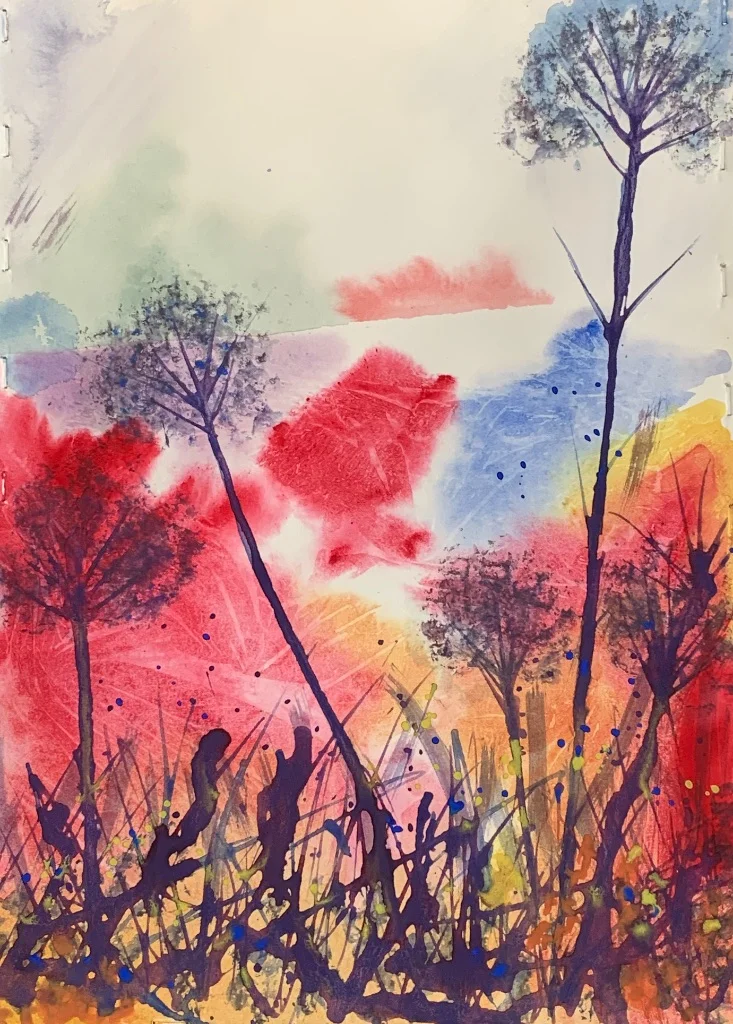
<p>Load a brush with paint and drag it wet across dry paper. Notice how it spreads, where it settles, how the edges dry. Then drop clean water into a wet wash and watch the bloom. Then drop a second colour into the first while it is still wet. This is wet-on-wet — the most characteristic technique in watercolour, and the one most beginners try to fight rather than use.</p>
<p>Spend two or three sessions making colour washes and gradients before you attempt a subject. You are not wasting time — you are learning the material. No amount of instruction can replace the physical understanding of how a loaded brush behaves on wet paper.</p>
<h2>The Six Colours You Need</h2>
<p>A beginner palette of six colours is more than enough to mix almost anything:</p>
<ul> <li><strong>French Ultramarine</strong> — the workhorse blue. Warm, granulating, beautiful in skies.</li> <li><strong>Cerulean Blue</strong> — cooler and cleaner than ultramarine. Better for bright sky passages and water.</li> <li><strong>Burnt Sienna</strong> — the most useful earth tone. Mixes with ultramarine to make near-blacks and beautiful warm greys.</li> <li><strong>Yellow Ochre</strong> — warm and muted. Invaluable for autumn light, stone, and understated greens.</li> <li><strong>Cadmium Yellow (or Hansa Yellow)</strong> — the clean, bright yellow for spring greens and flower passages.</li> <li><strong>Alizarin Crimson (or Permanent Rose)</strong> — a cold red with enormous mixing range. Essential for violets, roses, and cool flesh tones.</li> </ul>
<p>With these six you can mix greens, purples, oranges, browns, and near-blacks. You do not need green from a tube when you can mix ultramarine with yellow ochre and get something far more interesting.</p>
<h2>Understanding Transparency</h2>
<p>The fundamental difference between watercolour and every other paint medium is that it is transparent. You are not applying colour — you are filtering light. The white of the paper shines through the paint and creates luminosity. The moment you add white paint or use paint that is too thick and opaque, you lose that quality.</p>
<p>This means:</p> <ul> <li>Work light to dark, never dark to light</li> <li>Reserve your whites — keep the paper bare in the lightest areas rather than painting them out and coming back</li> <li>Build depth with layers of transparent colour, each one drying before the next</li> </ul>
<p>The instinct with watercolour is to keep adding paint to fix things. The discipline is to stop earlier than you think. A painting that feels unfinished is almost always better than one where you have overworked it trying to correct mistakes.</p>
<h2>Your First Subject</h2>
<p>When you are ready to attempt a subject, keep it simple and close to you. A single object — a mug, an apple, a plant pot — is far better than an ambitious landscape for your first attempt.</p>
<p>Look at it for longer than feels comfortable before you pick up a brush. Identify where the light is coming from. Notice the darkest dark and the lightest light. Decide what you are going to leave as bare paper. Then mix your lightest tone first, apply it, and wait for it to dry.</p>
<p>The single most valuable habit you can build as a watercolour painter is patience at the end of each wash — waiting until the paper is genuinely dry before adding the next layer. A hair dryer will help if you are impatient. Most mistakes in watercolour happen because the previous layer was not dry.</p>
<h2>When to Come to a Workshop</h2>
<p>Self-teaching watercolour from books and videos will get you some of the way. But there is a specific kind of progress that only happens when someone who knows the medium watches you work and tells you what you are doing right as much as what to change.</p>
<p>My workshops in Carshalton are specifically designed for people at this stage — after the initial kit purchase, after the first few sessions at home, when you know enough to know what you do not know. Three hours in a small group, working on a single subject, with full materials provided.</p>
<p>The most common feedback from workshop participants who have been self-teaching: "I have been fighting the paint. Now I understand I should have been working with it."</p>
<p><em>Upcoming workshops — Spring Flowers, Surrey Landscapes, Therapeutic Calm — are bookable at <a href="/workshops">simonrobinstephensart.com/workshops</a>. All materials included.</em></p>