<article>
<h1>How My Artwork Reached 600,000 People: Visiting The Salvation Army Headquarters in Denmark Hill</h1>
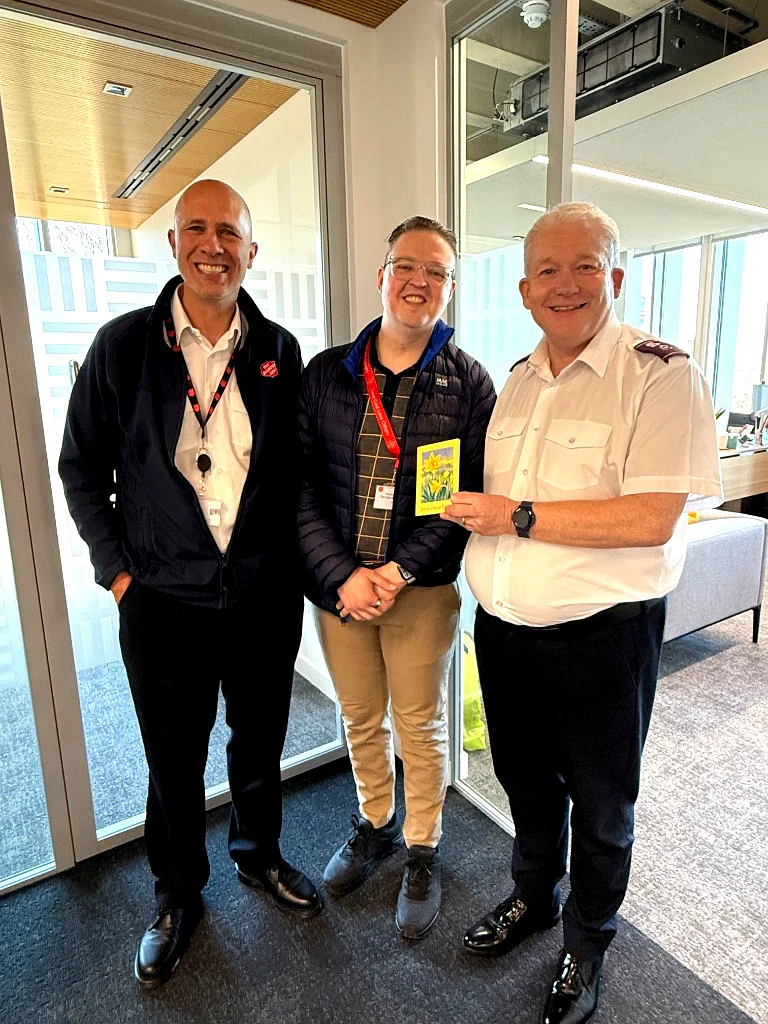
<figure class="blog-image" style="margin:0 0 2rem 0;"> <img src="/static/images/sa_hq_main.webp" alt="Left to right: Gordon Cotterill, Simon Robin Stephens, and Paul Main — Territorial Commander of The Salvation Army UK — at their Denmark Hill headquarters, holding the Easter card featuring Simon's daffodil watercolour" loading="eager" width="768" height="1024" style="width:100%;height:auto;border-radius:8px;" > <figcaption>Left to right: Gordon Cotterill, Simon Robin Stephens, and Paul Main — Territorial Commander of The Salvation Army UK — at their Denmark Hill headquarters, holding the Easter card featuring Simon's daffodil watercolour</figcaption> </figure>
<h2>How My Journey with The Salvation Army Began</h2>
<p>Never did I imagine, eight years ago, that stepping into a Salvation Army art wellbeing class would begin a journey that would shape my life.</p>
<p>What followed was something quiet but powerful.</p>
<p>From those early sessions, to working as a barista in the Sutton Salvation Army café — surrounded by people who genuinely care — while slowly honing my skills as an artist… I was finding something I didn't yet have words for.</p>
<p>A sense of calm.<br> A sense of direction.<br> A sense of purpose.</p>
<p>I didn't know it then, but that moment would quietly shape everything that followed.</p>
<p>And I certainly never imagined it would one day lead me here — standing outside The Salvation Army's Territorial Headquarters in Denmark Hill, with my artwork having reached 600,000 people across the UK.</p>
<h2>How the Daffodil Was Chosen</h2>
<p>Last March, I received a message that genuinely stopped me mid-painting.</p>
<p>A representative from The Salvation Army UK had been in touch to tell me that a watercolour daffodil I had painted — a quiet, sunlit study of a single stem catching the early spring light — had been selected for their 2026 Easter card campaign.</p>
<p>Six hundred thousand cards. Sent to supporters, churches, and communities right across the United Kingdom.</p>
<blockquote> <p>'We were looking for something warm, uplifting, and genuinely hopeful. Your daffodil had all of that. It felt like spring arriving.'</p> </blockquote>
<p>I sat with that for a long time.</p>
<h2>Why a Daffodil?</h2>
<p>Daffodils have always felt significant to me. They are one of the first things to push through after the cold — they arrive before you expect them, quietly confident, asking nothing in return. There is something about that early emergence that feels important when you live with ADHD.</p>
<p>Some days are long and grey and the momentum just is not there. And then something small appears — a shaft of light through cloud, a daffodil in the garden — and you are reminded that the season does turn. Things do move forward.</p>
<p>That is what I was painting. Not just a flower. A feeling.</p>
<h2>The Painting Process</h2>
<p>The daffodil study was painted on 300gsm Saunders Waterford cold-press paper using a limited palette — yellow ochre, cadmium yellow, a touch of raw sienna for the trumpet, and French ultramarine for the deep shadow passages. I worked wet-on-wet for the petals, letting the colour bloom outward and find its own edges. The background is a soft, diffused wash — cool greens and grey-blues that push the warm yellow forward without competing.</p>
<p>The whole painting took about forty minutes from first wet brush to final dry edge. That is the thing about daffodils — they reward the painter who works quickly and does not over-control. Hesitate, and the spontaneity is gone.</p>
<h2>The Visit — March 19th</h2>
<figure class="blog-image" style="margin:2rem 0;"> <img src="/static/images/sa_hq_team_visit.webp" alt="Simon Robin Stephens and Tati with the Salvation Army fundraising team including Rosie Littlejohns and Tiffany Lui at the Denmark Hill headquarters atrium" loading="lazy" width="1024" height="768" style="width:100%;height:auto;border-radius:8px;" > <figcaption>Simon Robin Stephens and Tati with the Salvation Army fundraising team — including Julius Wolf-Ingram (Head of Marketing and Fundraising), Rosie Littlejohns and Tiffany Lui — at their Denmark Hill headquarters</figcaption> </figure>
<p>On March 19th, I visited The Salvation Army's Territorial Headquarters in Denmark Hill to meet the marketing and fundraising team in person. I was welcomed by Julius Wolf-Ingram, Head of Marketing and Fundraising, along with team members Rosie Littlejohns and Tiffany Lui.</p>
<p>They showed me a physical example of the finished Easter card featuring my daffodil watercolour, and we talked through how it would be produced and distributed to Salvation Army supporters and churches across the UK. Seeing the card in person — knowing it would reach 600,000 people — was a genuinely moving moment.</p>
<h2>What Is the Hope Café at The Salvation Army Headquarters?</h2>
<figure class="blog-image" style="margin:1.5rem 0;"> <img src="/static/images/sa_hq_outside_selfie.webp" alt="Simon Robin Stephens and Tati outside The Salvation Army Territorial Headquarters in Denmark Hill" loading="lazy" width="1024" height="768" style="width:100%;height:auto;border-radius:8px;" > <figcaption>Me and Tati outside The Salvation Army Territorial Headquarters — Tati was the hospitality manager at Sutton Salvation Army and the person who arranged for all of this to happen. A very special thank you to her.</figcaption> </figure>
<figure class="blog-image" style="margin:1.5rem 0;"> <img src="/static/images/sa_hq_atrium_simon.webp" alt="Simon Robin Stephens standing in the stunning multi-storey wooden atrium at The Salvation Army Territorial Headquarters in Denmark Hill" loading="lazy" width="768" height="1024" style="width:100%;height:auto;border-radius:8px;" > <figcaption>Me in the Salvation Army HQ atrium — a breathtaking space filled with light and warmth</figcaption> </figure>
<p>Before anything else, my journey that day began with a coffee.</p>
<p>The Hope Café is a welcoming, light-filled space that reflects everything The Salvation Army stands for — warmth, dignity, and connection.</p>
<p>It provides opportunities for people gaining skills and confidence, while offering the community a calm, open place to sit, talk, and breathe.</p>
<p>In many ways, it mirrors what I try to create through my work as a watercolour artist — quiet spaces for reflection and calm.</p>
<h2>Meeting Gordon Cotterill and Paul Main</h2>
<figure class="blog-image" style="margin:2rem 0;"> <img src="/static/images/sa_hq_main.webp" alt="Left to right: Gordon Cotterill, Simon Robin Stephens, and Paul Main — Territorial Commander of The Salvation Army UK — at their Denmark Hill headquarters, holding the Easter card featuring Simon's daffodil watercolour" loading="lazy" width="768" height="1024" style="width:100%;height:auto;border-radius:8px;" > <figcaption>Left to right: Gordon Cotterill, Simon Robin Stephens, and Paul Main — Territorial Commander of The Salvation Army UK — at their Denmark Hill headquarters, holding the Easter card featuring Simon's daffodil watercolour</figcaption> </figure>
<p>The highlight of the visit was a moment I will not forget quickly.</p>
<p>It was wonderful to see Gordon Cotterill again — I already knew Gordon from Sutton Salvation Army, where he and his wife served as our church majors, so it was lovely to catch up with him in such a different setting.</p>
<p>I also had the honour of meeting Paul Main — Paul being the Territorial Commander of The Salvation Army UK, one of the most senior figures in the organisation. We stood together holding the Easter card, with my daffodil on the front.</p>
<p>There are moments in life that you can't quite plan for. That was one of them.</p>
<h2>What The Salvation Army Does</h2>
<p>The Salvation Army supports people through homelessness services, community support, food provision, addiction recovery, and modern slavery support.</p>
<p>This is real work that changes lives.</p>
<h2>What This Means for the Work</h2>
<p>I have been asked whether this changes how I think about painting. Honestly, no — and yes.</p>
<p>No, because the process remains the same. I still sit down with a blank sheet of paper, a jar of clean water, and a set of brushes. The painting still has to earn its existence one mark at a time. National recognition does not change that.</p>
<p>Yes, because it is a reminder that the quietest, most personal work often travels furthest. I was not painting for Easter cards. I was painting a daffodil because I needed to paint something hopeful that morning. That honesty — that private intention — is apparently what people recognise.</p>
<p>It feels right that a painting made to explore hope and resilience has found its way into an organisation built on exactly that. The Salvation Army do remarkable work — practical, compassionate, unglamorous work — and to have contributed something, however small, to their Easter message is genuinely meaningful to me.</p>
<h2>Limited Prints Available</h2>
<p>A limited run of prints of the daffodil painting is now available in the shop. Each is signed and numbered. I will be donating 25% from every print sold to The Salvation Army.</p>
<p>If you would like a print — or if you want to commission a similar study of a flower that means something to you — do <a href="/commission">get in touch</a>. Commissions are open and I am taking a limited number of spring projects.</p>
<p><a href="/shop">Explore my artwork collection</a></p>
<h2>Support The Salvation Army</h2>
<p>If this story resonates with you, you can support their work here:</p>
<p><a href="https://www.salvationarmy.org.uk/donate" target="_blank" rel="noopener noreferrer">Donate to The Salvation Army</a></p>
<p>Thank you to the Salvation Army for giving this painting a life I could not have imagined for it. And thank you to everyone who has followed along here. Your encouragement is part of why the work keeps happening.</p>
<p><em>Simon</em></p>
</article>