<p>There is a difference between looking at a painting and reading it. Looking is what happens in the first three seconds — the immediate response, the gut reaction. Reading is what happens if you stay with it longer. Reading is what changes "I like this" into "I understand why I like this, and I can talk about what I am seeing."</p>
<p>This distinction matters because it affects how you experience art. The person who can read a painting does not like it more or less than someone who simply looks. But they experience something richer. They catch more. And — not unimportantly — they can tell an artist what they are responding to, which helps if you are ever considering a commission.</p>
<p>Here is how to read a watercolour painting.</p>
<h2>Start with light, not subject</h2>
<p>Most viewers start by identifying the subject: "It is a river." "It is a cottage." "It is a field." This is fine, but it is the least interesting thing about most paintings.</p>
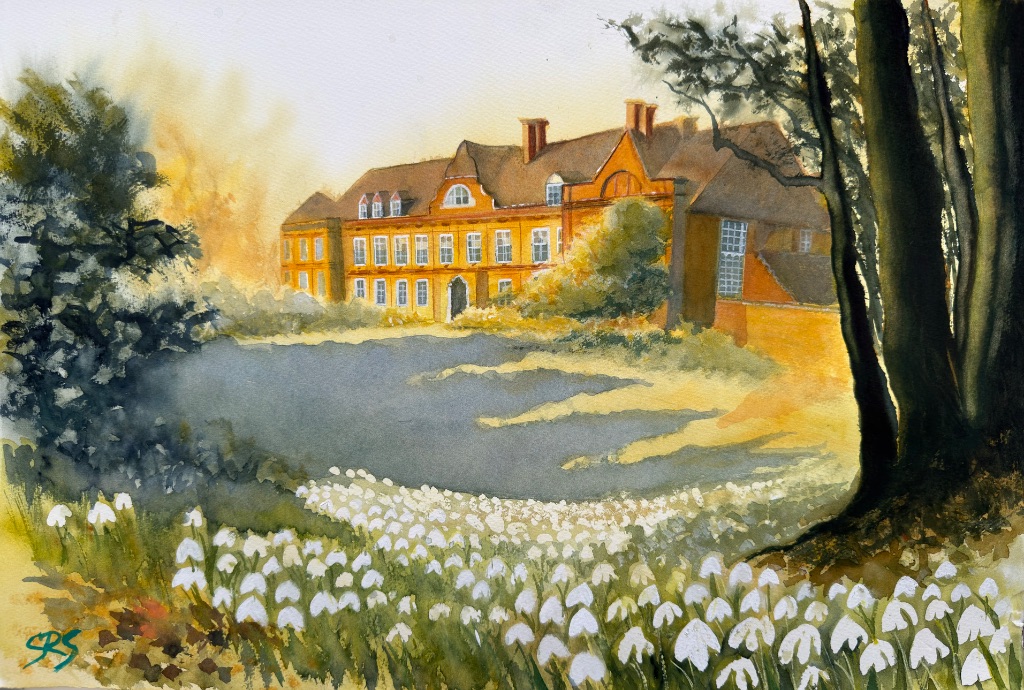
<p>Before you identify the subject, try to see the light. Where is it coming from? What direction? Is it soft and diffuse — the kind of overcast British light that makes shadows almost disappear — or is it directional and hard, with crisp shadows? Is it warm (golden, amber) or cool (grey-blue)?</p>
<p>In watercolour, light is handled differently than in any other medium. The white of the paper is the lightest value available — the artist does not paint light, they leave it. So the brightest areas in a watercolour are literally where nothing has been painted. This is worth looking for. Where has the artist deliberately left the paper? Those areas are not absence — they are active decisions.</p>
<h2>Look at the edges</h2>
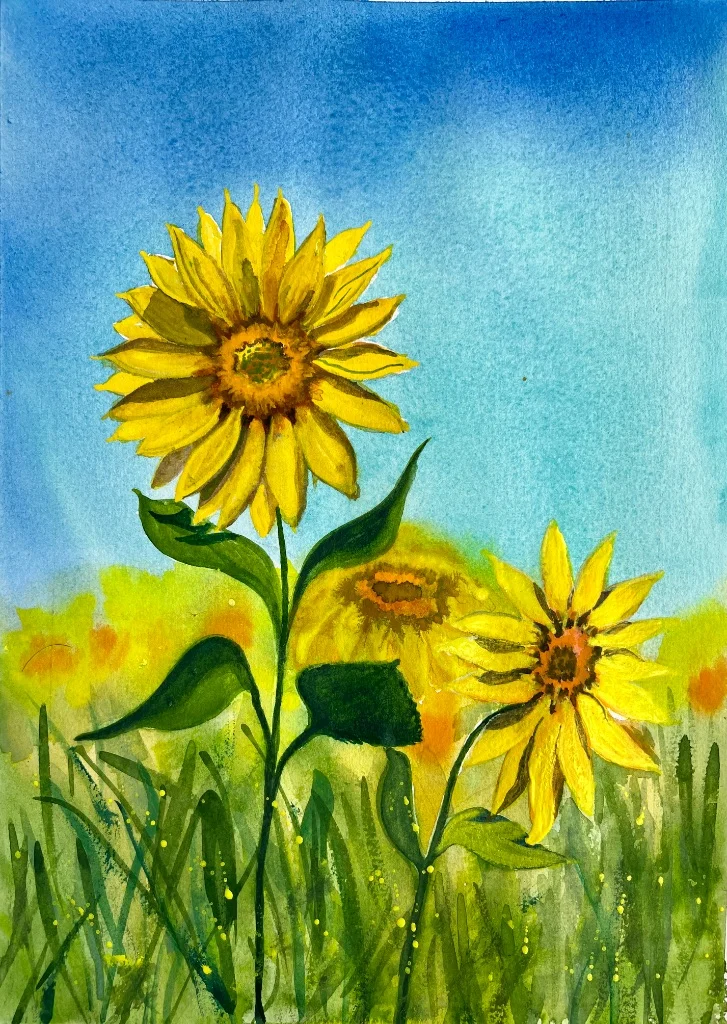
<p>In watercolour, edges are one of the most expressive tools available. Hard edges (crisp, clearly defined boundaries between shapes) bring things forward and create focus. Soft edges (where colours blend or blur into one another) push things back and create atmosphere. Lost edges (where shapes dissolve completely into background) create depth and mystery.</p>
<p>A skilled watercolourist will typically use hard edges for the focal point of a painting — the thing they most want your eye to land on — and softer, more lost edges for everything else. If you look at a painting and find your eye being consistently drawn to one area, that is probably where the hardest edges are.</p>
<p>You can test this: look at the painting, then deliberately move your eye away from where it wants to go. What is different about those peripheral areas? They are almost certainly softer.</p>
<h2>The value structure</h2>
<p>Value means the lightness or darkness of a colour, independent of the colour itself. If you take a black-and-white photograph of a painting, what you see is the value structure. This is often more important than colour to the overall impression of a painting.</p>
<p>Strong value contrast — dark darks next to light lights — creates visual drama and punch. Low contrast (everything in a similar mid-range of grey) creates quietness and calm. Many of my landscapes have low value contrast because the subjects — the Ponds, the Surrey Hills in diffuse light — are genuinely low-contrast environments. That is part of what makes them feel peaceful.</p>
<p>Try squinting at a painting — seriously, half-close your eyes. This reduces colour and detail and lets you see the underlying value pattern. Does it hold together? Is there a clear sense of where the lights and darks are? A painting that works in value will hold together even when reduced to near-silhouette.</p>
<h2>Colour temperature</h2>
<p>Colours have temperature — warm (reds, oranges, yellows) and cool (blues, greens, purples). This is not just a visual fact; it carries emotional weight. Warm colours advance and energise. Cool colours recede and calm.</p>
<p>In landscape painting, light is typically warm and shadows are cool (or vice versa, depending on the time of day and weather). This warm/cool contrast is often what gives a painting a sense of sunlight without the artist having to do anything particularly dramatic. Look for where the painting shifts from warm to cool — that shift is often where the most interesting things happen.</p>
<h2>Composition: where the eye travels</h2>
<p>Composition is the arrangement of shapes within the picture frame. A considered composition leads your eye through the painting in a particular sequence, landing on particular points, resting in certain areas.</p>
<p>Some things to look for:</p>
<ul> <li><strong>Entry point:</strong> Where does your eye enter the painting? Usually at a point of high contrast or a strong shape near the edge or corner.</li> <li><strong>Focal point:</strong> Where does your eye want to rest? This is usually the most detailed, highest-contrast part of the painting.</li> <li><strong>Movement:</strong> Is there a sense of the eye being carried through the image? Diagonal lines, rivers, paths, and rows of trees are classic compositional devices for creating this movement.</li> <li><strong>Breathing room:</strong> Good compositions usually have areas of simplicity — sky, plain water, open fields — that let the eye rest before moving on.</li> </ul>
<h2>What the medium is doing</h2>
<p>Watercolour has its own vocabulary of effects that are specific to the medium. Knowing what they are helps you appreciate them:</p>
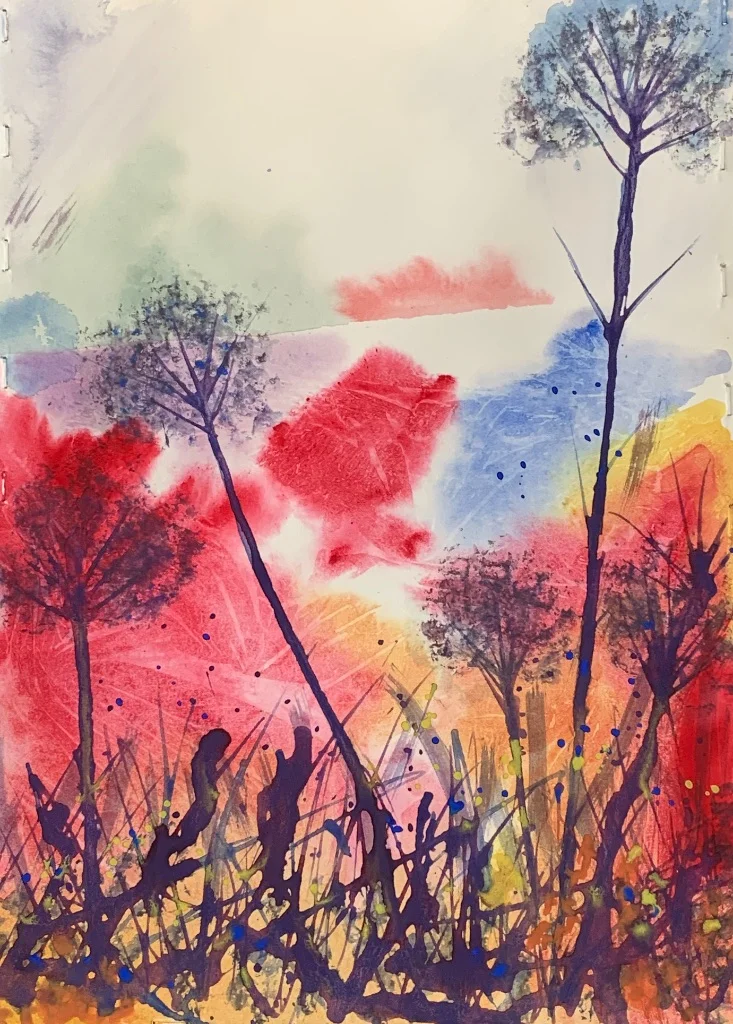
<ul> <li><strong>Wet-on-wet blooms:</strong> When wet paint is dropped into wet paper, it creates soft, irregular blooms of colour with ragged edges. These are unmistakably watercolour. They are almost impossible to control precisely, which means when they work, they feel lucky and alive.</li> <li><strong>Granulation:</strong> Some pigments separate out on the paper as they dry, creating a textured, grainy appearance — like sediment settling. Ultramarine and French ultramarine, cobalt blue, and some earth pigments do this beautifully.</li> <li><strong>Glazing:</strong> Transparent washes laid over dried layers create depth without muddying — you can see through to the layers below. This is what creates the luminous quality that oil paint cannot easily replicate.</li> <li><strong>Lifting:</strong> Wet paint can be lifted with a dry brush or tissue to create lighter areas or soft highlights. Look for soft, slightly irregular lighter passages — that is often lifting.</li> </ul>
<h2>The question of intention</h2>
<p>The most rewarding question when reading a painting is: what was the artist trying to do? Not "did they succeed?" (yet) — just: what is the intention here?</p>
<p>Is the painting trying to capture a quality of light? A mood? A specific time of day? The character of a place? Once you have a sense of the intention, you can evaluate how well the painting realises it. This is much more interesting than simply assessing whether it is "realistic" or "technically accomplished."</p>
<p>If you are ever at one of my exhibitions and want to ask me about a specific piece — what I was trying to do, what the conditions were, what I am most happy with — I genuinely love those conversations. It is the best version of what exhibitions can be: a slow looking at things made with care, with someone on hand who can tell you why.</p>
<p>In the meantime, you can see the current collection in the <a href="/gallery">gallery</a>, and if something catches your eye, you can read more about my process on the <a href="/about">about page</a>.</p>