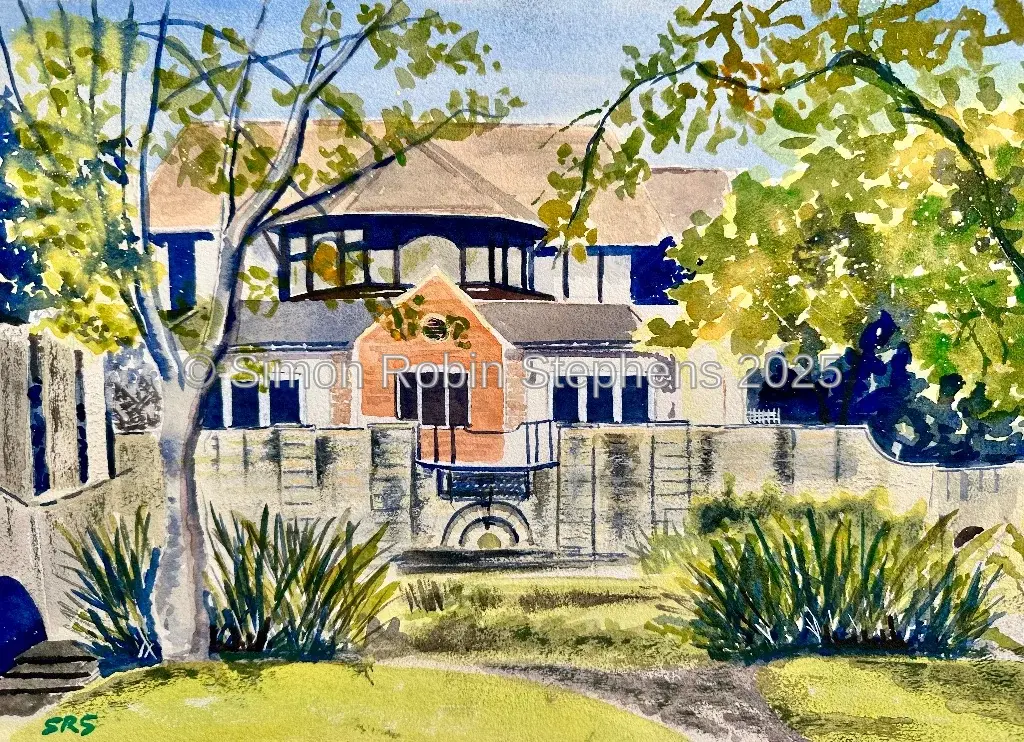
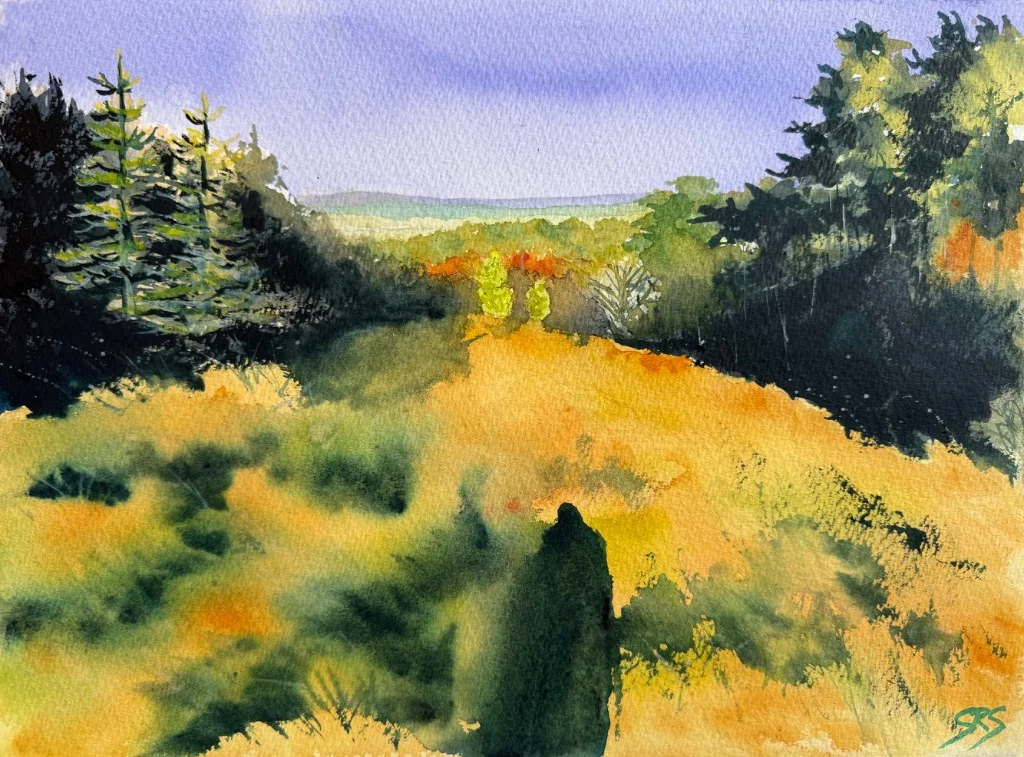
There is a painting in my studio that I made standing under a golf umbrella on the North Downs in November. The rain was coming in sideways. My palette was wet. My jacket was soaked through. And the finished piece — soft edges, luminous greys, that particular silvery quality the sky gets when it's about to do something decisive — is one of the best things I've ever painted.
I don't say that to boast. I say it because it surprised me. When I set out that morning I fully expected to produce something acceptable and go home cold. What I came back with was a painting that felt genuinely alive in a way that blue-sky days rarely deliver.
That's the paradox British watercolourists have known for two hundred years: the weather that drives tourists indoors is the weather that makes the light extraordinary.
Why Overcast Light Is Actually Ideal for Watercolour
On a bright sunny day, everything has hard edges. The shadow under a tree is a sharp, dark shape. The glare off the surface of a pond is a blinding stripe. The contrast is so high that capturing it accurately requires either technical precision or a willingness to simplify brutally.
Watercolour, by nature, resists precision. It blooms. It bleeds. Edges soften whether you want them to or not — especially on wet days when the paper itself is slightly damp before you even start.
On an overcast day, that tendency becomes an asset. The light is already diffuse. Shadows have soft edges. Every tone is a half-tone. The whole landscape is pre-watercolourised, in a sense — the natural world has done the translation work for you, and your job is simply to record what's already there.
The French Impressionists called it lumière grise — grey light — and valued it above all others for plein air work. Constable painted the Suffolk skies in every possible state of drama. Turner would walk into storms on purpose. This is not a modern eccentricity. It is a tradition.
What Rain Does to Colour
Here is something I noticed early on and couldn't quite explain until I thought about it properly: wet surfaces saturate. When the pavements are wet, the brick is a deeper red. The mud is a richer brown. The bark on a silver birch goes from pale grey-white to almost charcoal. The grass — even suburban grass — becomes the colour of something tropical.
Watercolour loves saturated colour applied wet-into-wet. Rain gives you permission to use the richest pigment in your palette without it looking wrong, because the world in front of you is already doing the same thing.
On Box Hill after rain, the chalk soil goes from pale cream to a deep tawny amber. The juniper on the upper slopes shifts from dusty green to near-black. The sky over the North Downs in December, just after a heavy shower, has this particular quality of pewter shot through with cold violet that I have never managed to fully capture but keep trying to.
Practical Kit for Painting in British Weather
I've refined my wet-weather kit over several years of refusing to stay indoors:
- A large golf umbrella — not a walking umbrella, not a compact travel one. You need something that keeps both you and your palette dry. Clamp it to your easel arm if you can, or accept that you'll be holding it with your elbow.
- Aquarelle papers only — on damp days, cheaper papers buckle badly and start behaving unpredictably. I use 300gsm cold press. On very wet days I pre-wet and stretch it the night before.
- Half-pans over tubes — tubes squeezed onto a palette go runny fast in rain. Hard half-pans hold their consistency better and don't slide around.
- A minimal palette — in wet conditions, you want to work fast and decisively. Six colours maximum: a warm yellow, a cool blue, a red-brown, a blue-grey, a warm green, a neutral dark. Mixing on the fly is harder when everything's damp.
- A plastic bag over your sketchbook hand — sounds ridiculous, looks ridiculous, keeps your paper dry long enough to get something down.
The Speed Advantage
Painting outdoors in rain forces you to work fast. You don't have the luxury of standing back and deliberating for three minutes. The light is moving — cloud cover changes the tone values constantly — and if you don't commit, you'll be chasing something that no longer exists.
This pressure is, counterintuitively, a gift.
The strongest watercolours I have ever made were made quickly. Not carelessly — quickly. There's a difference. Careless means you haven't looked. Quick means you've looked very hard indeed and then trusted your hand to catch up with what you saw.
Rain strips away the option of fussing. You put down a wash and you leave it. You can't go back and fiddle with a passage that's already drying because another storm is coming over the North Downs and you need to capture the sky before it changes again.
The resulting work has an energy that studio paintings sometimes lack. You can feel, in the handling, that it was made under pressure and in the actual presence of the thing it's describing.
Where I Go When the Weather Turns
Within a mile of my studio in Carshalton, I have half a dozen locations that transform in bad weather:
Carshalton Ponds — the chalk-stream water goes the colour of steel in rain. The mill house reflects perfectly. The willows, which look pleasant on sunny days, become genuinely dramatic when the wind catches them.
The Ecology Centre, Hackbridge — the reed beds in November fog are one of the more extraordinary sights in South London. You could be in Norfolk.
The North Downs above Coulsdon — when cloud is sitting on the escarpment you get these extraordinary soft-edged views where the middle distance just dissolves. The chalk path disappears into grey. It's pure poetry to paint.
Beddington Park in autumn rain — the horse chestnuts drop all at once in a wet October. The grass is full of conkers. The river Wandle runs fast and brown. The whole scene has a Constable quality that is not available any other time of year.
A Note on Embracing Difficulty
I think there is something instructive about choosing to paint in conditions that most people would consider obstructive. It's part of the same practice that makes watercolour useful for managing ADHD — the discipline of attending to what is difficult rather than retreating to what is easy.
Rain doesn't care that you planned a sunny morning session. The light changes because the light changes. Your job is to adapt, stay present, and find the painting that's available to you rather than mourning the one you'd imagined.
That's as useful a life lesson as anything I've encountered in a therapy room.
If you'd like to paint outdoors in all weathers with guidance, my workshops run year-round. We don't cancel for rain.