<p>People ask me occasionally what I do all day. The romantic answer involves a sun-lit studio, a cup of tea going cold, and hours of uninterrupted creative flow. The honest answer involves walking, looking, a lot of not-painting, some painting, emails, a broken brush, and — if it's been a good week — one finished piece that I'm genuinely pleased with.</p>
<p>This is what a working day in my studio actually looks like.</p>
<h2>6:30am — The Walk</h2>
<p>I don't start at the easel. I start outside.</p>
<p>Walking is not separate from painting — it's the first act of it. I take the same route most mornings: out through the park behind the house, past the Ponds if I have time, and back along the old railway path. I'm not exercising, exactly. I'm looking. Every morning the light is different, and the discipline is noticing how.</p>
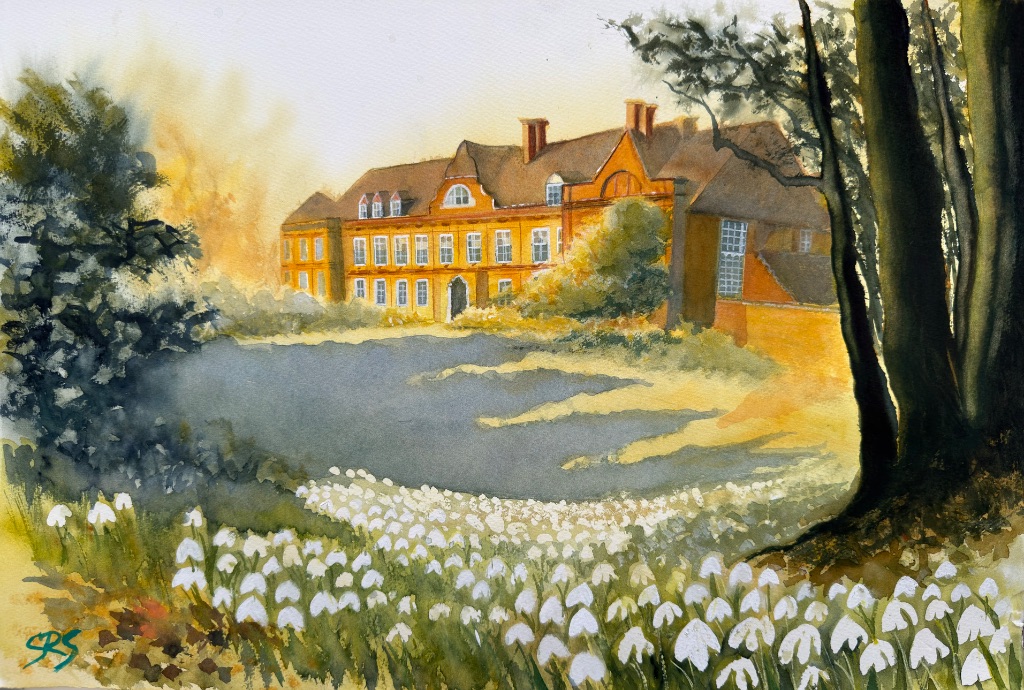
<p>I carry a small sketchbook in my jacket pocket and a stub of graphite. Most days I don't use them. The looking is enough. But occasionally something stops me — the angle of early sun on the mill house brickwork, the specific green of moss on a wet stone, a heron absolutely motionless in the shallows — and I make a quick mark to record it before it changes.</p>
<p>I came to this practice partly out of necessity (ADHD means I need to start the day with physical movement or I can't concentrate afterwards) and partly because John Ruskin was right: you cannot paint what you haven't properly looked at.</p>
<h2>8:00am — Studio Prep</h2>
<p>My studio is a converted spare room. It's not large. The north-facing window means I get flat, consistent light most of the day, which matters more than size. I have a large trestle table, a drawing board that I tilt to about thirty degrees, a rolling metal trolley for paints and water jars, and a wall of pinboards for reference photos, colour notes, and half-finished ideas.</p>
<p>Prep takes longer than people expect. I have to decide what I'm working on — usually this means looking at what's on the pinboard and asking which one is most alive to me right now, not which one I 'should' do. Forcing myself to work on a commission when my head is full of a landscape I want to paint rarely ends well for either piece.</p>
<p>I stretch paper if I'm starting something fresh — 300gsm Bockingford or Saunders Waterford, soaked in the bath for fifteen minutes and stapled to a board while wet. This is an act of commitment: you don't do that and then not paint. It's a useful psychological trick for getting started.</p>
<h2>9:00am to 12:30pm — Painting Time</h2>
<p>This is the core of it. I try to protect this block with something close to ferocity. Phone on silent. Email closed. No social media. No "just quickly checking" of anything.</p>
<p>The work itself is hard to describe because it's mostly invisible from the outside. A lot of standing back and looking. A lot of mixing a wash and then deciding not to use it. Occasionally a moment of genuine flow where everything goes down exactly as intended and the painting advances rapidly. More often a slower, more uncertain process of building washes in layers, waiting for drying between each one, asking constantly: is this right? Should this edge be soft or hard? Is the tonal value here too light, too dark?</p>
<p>I work on three or four pieces at once in most sessions. While one dries I'll add a wash to another. Waiting is built into watercolour's logic — you cannot rush it — and working across several pieces means the waiting becomes productive rather than frustrating.</p>
<p>I listen to Radio 4 or audiobooks while I work. Not music — music pulls my attention into itself and I start listening to it rather than looking at the painting. Speech is different: my brain processes it in the background and the narrative flow actually helps me stay focused. Anyone who tells you artists need silence hasn't spent much time with an ADHD brain.</p>
<h2>12:30pm — Lunch and Looking</h2>
<p>I eat lunch in the studio. The real reason is that I want to look at whatever I was working on this morning from a distance, without touching it. Paintings look different after you've stopped thinking about them. Problems you couldn't see at 11am become obvious at 12:30. Solutions present themselves without effort.</p>
<p>Sometimes I photograph the work-in-progress during this time and make notes on my phone about what needs doing in the afternoon. Sometimes I just look. Both are useful.</p>
<h2>2:00pm — Admin, Emails, and Everything Else</h2>
<p>The afternoon is for everything that isn't painting.</p>
<p>Correspondence: commission enquiries, workshop registrations, messages from collectors. I try to answer all of these personally. A form reply to someone who's described exactly why your painting matters to them feels like a betrayal.</p>
<p>Photography: finished paintings need to be photographed properly before they're listed. I have a daylight setup by the window — white foam boards, a reflector, natural light. Getting a true colour record of a watercolour is surprisingly difficult; the pigments have a luminosity that a phone screen can only approximate.</p>
<p>Website updates: adding new work to the gallery, updating workshop listings, writing. I wrote this blog post in two afternoon sessions.</p>
<p>Supply runs, framing decisions, stretcher orders. The logistical underside of the practice.</p>
<h2>4:00pm — The Good Hour</h2>
<p>This is the part that surprised me most when I started paying attention to my own rhythms: I have one really good painting hour in the late afternoon. The light in the studio at 4pm in autumn is extraordinary — the sun is low and the room goes warm and amber — and something about the end of the day makes me less precious about the work.</p>
<p>The morning is careful and deliberate. The late afternoon is freer. I take risks I wouldn't take at 9am. Some of them fail. Some of them produce the best passages in a painting.</p>
<p>If there's a piece I'm struggling with — something that's technically competent but feels dead — I'll often come back to it at 4pm and do something decisive to it. Cut through a passage with a damp brush. Add a shadow I've been avoiding. Either it rescues the painting or it doesn't, but at least I've stopped it being mediocre.</p>
<h2>5:30pm — Tidying and Thinking</h2>
<p>I wash brushes carefully — a good watercolour brush is an expensive thing and washing it badly shortens its life dramatically. I close palettes. Put wet paper aside safely. Clear the water jars.</p>
<p>Then I sit for five minutes and look at what the day produced. Sometimes very little. Sometimes something I'm genuinely surprised by. The ratio of good days to frustrating ones is roughly what you'd expect if you knew that mastery in any medium takes ten thousand hours and I have perhaps three thousand under my belt.</p>
<p>The work is not always good. The practice is always valuable.</p>
<h2>What's Not in This Account</h2>
<p>I've left out the days when I stand in front of a blank sheet for two hours and produce nothing. The pieces I abandon halfway through because they've stopped being true. The commissions that take three attempts before they're right. The weeks when the ideas dry up and I do administrative work and go for walks and wait for something to return.</p>
<p>Those are as much a part of the practice as the paintings that work. Any account that omits them is selling a fantasy rather than describing a reality.</p>
<p>The reality is that making watercolour paintings for a living is mostly a commitment to showing up — to the studio, to the sketch walk, to the slow process of learning to see more accurately than you could yesterday. The paintings come from the practice, not the other way round.</p>
<p>If you'd like to experience the practice for yourself, my <a href="/workshops">workshops</a> are open to complete beginners. I teach the way I learned — outdoors, looking first, painting second, with a lot of patience built in for the bit in between.</p>