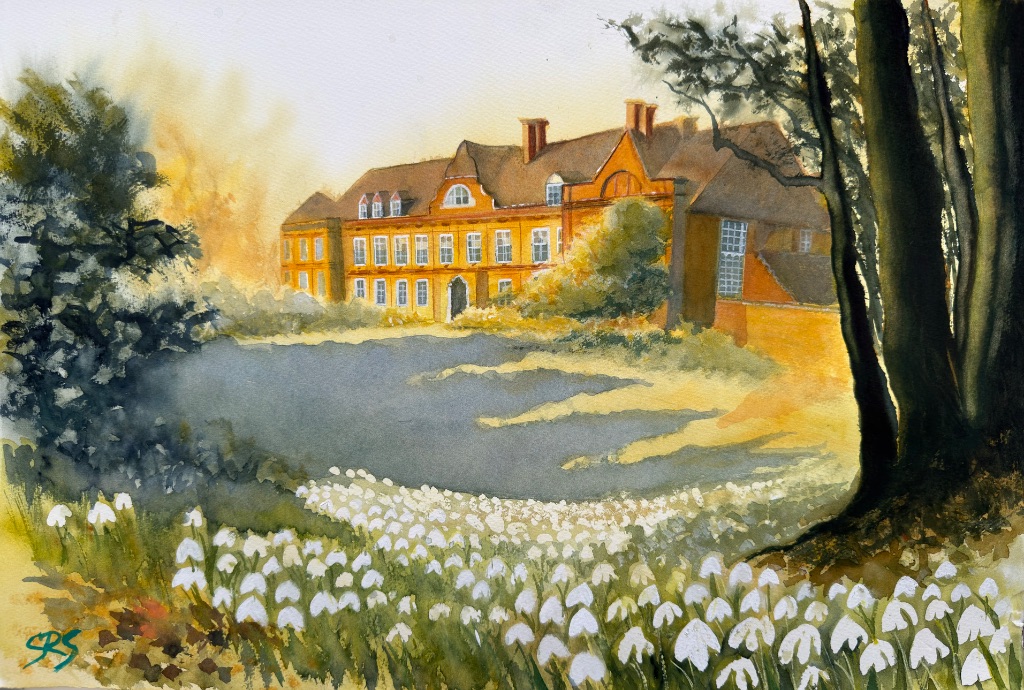
<p>Framing a watercolour painting is one of the most consequential decisions you will make about the work. The right frame — the right mat, the right glass, the right proportions — can elevate a painting considerably. The wrong choices can diminish it, sometimes in ways that are difficult to articulate but immediately visible. After years of framing my own watercolours for exhibitions, sales, and commissions, here is what I have learned.</p>
<h2>Why Framing Watercolour Is Different</h2>
<p>Watercolour on paper has specific requirements that differ from oil or acrylic on canvas. The paper needs to breathe slightly and must not be mounted flush against glass, because moisture can cause the paper to buckle and the paint to adhere to the glass surface. This is why a mat — also called a mount — is not just an aesthetic choice: it is a functional requirement.</p>
<p>The mat creates the necessary gap between the painting and the glass. A minimum depth of around 3mm is needed, though most professional mats provide 1.5–3cm of border, which both protects the work and creates visual breathing room around the image.</p>
<h2>Choosing the Right Mat</h2>
<p>Mat colour is the first decision and the one that most affects how the painting reads. My strong default position is off-white or cream — a warm white with a slight ivory tone. Pure, bright white can cool a watercolour and make the colours look washed out. Cream warms the palette without dominating it. This is the choice I make for the vast majority of my own work.</p>
<p>Coloured mats — grey, black, dark navy — can work beautifully for certain paintings, particularly darker, more atmospheric work. A deep charcoal mat around a moody evening landscape can be striking. But coloured mats require confidence, and when they go wrong they compete with the painting rather than supporting it.</p>
<p>Double mats — a thinner inner mat of a slightly different tone — add a subtle sophistication and are worth considering for work going to exhibition or for a significant commission. The inner mat is usually cut a few millimetres smaller than the outer, creating a narrow reveal of a different tone around the image.</p>
<h2>Mat Board Quality: Conservation Matters</h2>
<p>Use conservation-grade or museum-quality mat board. Cheap mat board contains acids that will migrate into the paper over time, causing yellowing and foxing — the brown spots that appear on improperly stored work. This is not a marginal risk on a long timescale; it is a documented, predictable outcome. Conservation mat board is not significantly more expensive, and the alternative is damage to the painting itself.</p>
<p>The mat board should be acid-free and lignin-free. Reputable suppliers in the UK include Larson-Juhl and Nielsen, but any professional framing supplier will stock the appropriate materials. If you are having work framed by a framer, ask specifically whether they use conservation-grade materials — the better framers will default to it, others will use it if asked.</p>
<h2>Glass: UV Protection Is Non-Negotiable</h2>
<p>Watercolour is more light-sensitive than oil or acrylic. The pigments can fade significantly with prolonged UV exposure — some colours more than others, but fading is a general risk. UV-protective glass or acrylic (Perspex) is not optional for any work that will hang in a location with natural light.</p>
<p>Standard UV-protective glass filters approximately 99% of UV radiation. Museum-quality glass (such as Tru Vue Museum Glass or Denglas) goes further, offering both UV protection and anti-reflection properties. For exhibition work or significant commissions, museum glass is worth the additional cost — the reduction in glare makes the painting considerably more visible and the lack of a visible glass surface creates an almost frameless appearance.</p>
<p>Acrylic glazing (Perspex) is lighter than glass, which matters for large works, and offers comparable UV protection. It scratches more easily than glass, which is a consideration for work that will be handled or transported frequently.</p>
<h2>Frame Profiles: What Works with Watercolour</h2>
<p>The frame profile — the shape and width of the moulding — should not compete with the painting. For watercolour, I tend towards clean, relatively narrow profiles: a simple flat white or natural wood, or a thin gilt frame for more traditional work. Heavily ornate gilt frames can overwhelm a delicate watercolour. Very wide, sculptural profiles can make the mat appear insufficient.</p>
<p>A useful rule of thumb: the total visual weight of mat plus frame should direct the eye towards the painting, not towards itself. When in doubt, the quieter option is usually the right one.</p>
<p>Natural wood — light oak, pale ash, or unstained frames — works particularly well with landscape and nature subjects. White or off-white frames suit more contemporary interiors. Traditional gilt suits representational, classical subjects. Dark frames (ebony, dark walnut, black) suit more dramatic or high-contrast work.</p>
<h2>Proportions: How Wide Should the Mat Be?</h2>
<p>A common error is under-matting: cutting the mat too narrow so that the painting looks crowded and cramped. The mat should be generous. For an A4 painting, a mat with a 4–5cm reveal is a minimum. For an A3, 5–7cm. For larger work, proportionally more.</p>
<p>The bottom of the mat is often cut slightly wider than the top and sides — typically 5–10mm more — because a mat that is optically centred tends to read as bottom-heavy. This is a traditional convention in framing and worth following for formal presentation.</p>
<h2>Mounting the Painting</h2>
<p>The painting should be hinged to the backing board with acid-free, reversible hinge tape — typically Japanese tissue and wheat starch paste, or purpose-made conservation hinge tape. The hinge should be at the top edge only (T-hinges), allowing the paper to expand and contract with changes in humidity without buckling.</p>
<p>Never dry-mount a watercolour on paper. Dry mounting — which uses a heat-activated adhesive to bond the paper to a board — is irreversible, can cause the paper to bubble with humidity changes, and traps the paper against a surface in ways that can damage the work over decades. If someone offers to dry-mount your watercolour, decline.</p>
<h2>Sizing for Exhibition and Sale</h2>
<p>When preparing work for exhibition or sale, it helps to frame to standard sizes where possible. Standard UK frame sizes (A4, A3, A2, 50×40cm, 60×50cm, and so on) make work easier to display, transport, and replace with identically-sized works. Custom sizes are sometimes unavoidable, but standard-sized framing reduces cost, simplifies logistics, and makes work more practical for buyers to re-frame if they choose to.</p>
<p>At exhibitions, I include a note with each work giving the image size and the frame size separately — buyers sometimes want to know whether a piece will fit an existing frame or a particular wall space.</p>
<h2>A Note on DIY Framing</h2>
<p>It is entirely possible to frame watercolours yourself to a professional standard, particularly for smaller works. The key investments are a quality mat cutter (a Logan or Keencut mat cutter is a good starting point), conservation mat board, UV glass, and good frame moulding. The learning curve is in the mat cutting — getting clean, consistent 45-degree bevelled cuts requires practice. But the results are satisfying and significantly cheaper than professional framing for volume work.</p>
<p>For exhibition pieces or high-value commissions, I use a professional framer — the quality of finish and the precision of the mat cut is worth the additional cost when presentation matters most.</p>
<h2>Summary: The Essentials</h2>
<ul> <li>Always use a mat — never mount a watercolour directly against glass</li> <li>Use conservation-grade, acid-free mat board</li> <li>Use UV-protective glass or acrylic</li> <li>Choose off-white or cream mat as your default starting point</li> <li>Make the mat generous — err on the side of too wide, not too narrow</li> <li>Use reversible hinge mounting, never dry-mounting</li> <li>Keep the frame profile quiet and supportive of the painting</li> </ul>
<p>Framing is a craft in its own right, and the decisions you make matter. A painting that has been thoughtfully framed will hold its condition for decades and present itself well in any context. It is worth getting right.</p>
<p>If you have questions about framing specific works or are interested in how I frame commissions and exhibition pieces, you are welcome to get in touch through the <a href="/contact">contact page</a>.</p>