<p>When I tell people I paint watercolour landscapes, the follow-up question is usually about portraits. "Have you ever tried portraits?" or "Do you paint people?" or, from other artists, "You'd make much more money painting faces." All of these are reasonable observations. Portraits are some of the most sought-after and financially valuable paintings in the contemporary market. Skilled portrait commissions command three, five, ten times what I charge for a landscape of equivalent size and quality.</p>
<p>So why landscapes? The honest answer has nothing to do with market positioning or brand strategy. It has to do with what happens inside me when I paint.</p>
<h2>Faces Ask Too Much</h2>
<p>I have painted faces. In my earlier work — before I began to understand what painting actually was for me — I tried portraits. Still lifes, figurative work, the occasional study of a person in a street scene. I was competent at it. But something was always wrong, always uncomfortable, in a way I could not identify at the time.</p>
<p>What I know now — after my ADHD diagnosis and several years of thinking carefully about why certain kinds of work drain me and others restore me — is this: painting a face triggers a social attention system that I find exhausting. Faces are never neutral subjects. Every decision I make while painting a face — the expression, the likeness, the personality conveyed or missed — is evaluated against a social standard. Am I representing this person truthfully? Does this look like them? Will they be hurt or pleased or indifferent?</p>
<p>That constant referencing to a social standard does not happen with a landscape. A hillside does not have feelings about whether I've captured it accurately. The light on water does not care if I've missed it by two values. Painting a landscape allows me to look with full intensity and respond without the social commentary running underneath.</p>
<h2>A Landscape Holds Still</h2>
<p>There is a practical reason too. A landscape, unlike a person, holds still long enough to be understood. Light changes — of course it does — but the structure of a hillside, the relationship between a tree and the water it stands beside, the horizon line across a flat common: these are stable enough to work from.</p>
<p>The ADHD brain struggles with complex, rapidly changing social information. It is not that I cannot process it — it is that the processing cost is so high that it crowds out the actual painting. With a landscape, my brain's processing is directed at the visual: tone, colour, edges, composition. The cognitive load is manageable and it is exactly the right kind of difficulty — the kind that demands attention without overwhelming it.</p>
<p>This is not a limitation I resent. It is a discovery about how my mind works best, arrived at by paying attention to the evidence of my own experience. The painting practice and the self-knowledge developed together.</p>
<h2>Landscapes Are About Something Larger Than Me</h2>
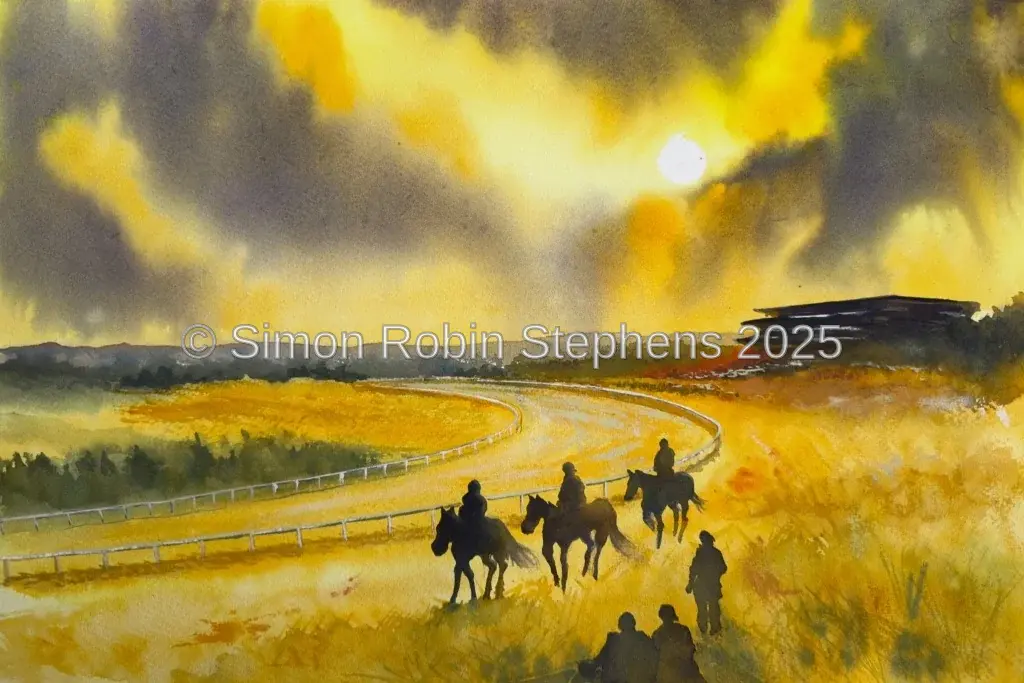
<p>There is a third reason, which is harder to articulate without sounding grandiose. Landscapes point beyond themselves. When I paint Buckland Lake, or Box Hill, or the North Downs in late autumn, I am painting something that existed long before me and will continue long after. The landscape is not about my feelings, or my skill, or my particular afternoon. It is about a place — a specific, real, durable place.</p>
<p>Portraits, by contrast, are necessarily about the person painted. However much technique is involved, the subject of a portrait is ultimately a face — this face, this expression, this life. That is not a lesser subject. It is a profound one. But it is not the kind of subject that restores me.</p>
<p>What restores me is the act of looking at something that will outlast us both. The chalk hills of Surrey were here before my great-grandparents were born. The clear water of Carshalton's chalk streams has been running since the last ice age shifted north. Painting these things is a form of attention that feels, to me, like the opposite of the anxiety and noise that ADHD can produce. It is a way of getting outside my own head by attending carefully to something much larger than it.</p>
<h2>The Therapeutic Logic</h2>
<p>The word "therapeutic" gets attached to my work a lot, and I am comfortable with it, but it is worth being precise about what it means here.</p>
<p>I do not paint landscapes because I find it relaxing. Painting is often genuinely hard work — technically demanding, frustrating, full of decisions that could go wrong. What is therapeutic about it is the quality of attention it requires. Painting a landscape demands that you look at something outside yourself with sustained, careful, non-judgemental attention. You are noticing the world as it is, not as you would like it to be or fear it might be.</p>
<p>That is not the same as relaxation. It is closer to the kind of full engagement that psychologists describe as flow — where the task and the skill are matched closely enough that the self temporarily disappears. For me, that happens reliably with landscapes and very rarely with any other kind of subject.</p>
<h2>What About the Market?</h2>
<p>The question of commercial viability is real and I do not dismiss it. Portraits do command higher prices. A skilled portraitist who also paints landscapes will almost always make more money from the portrait side of their practice.</p>
<p>But the commercial argument assumes I can paint both equally well — and I cannot. A portrait painted under the conditions I have described (the social attention cost, the crowding of the cognitive bandwidth I need to actually paint) will not be as good as a landscape by a painter who paints landscapes because that is where their attention genuinely goes.</p>
<p>The most expensive painting is the best painting. The best painting is the one made with full attention. My full attention goes to landscapes. So that is what I paint.</p>
<h2>A Note on Commissions</h2>
<p>People occasionally ask whether I will paint their pet, their child, or their house in a realistic figurative style. I can paint the house — and I enjoy painting buildings, which are architectural subjects that fall within the same attentional category as landscapes. I do not take on portrait commissions for people or animals as a rule.</p>
<p>What I do take on is landscape commissions — paintings of places that matter to people. A garden, a view from a window, a stretch of coast where someone's family has always gone. These are commissioned landscapes that carry the same emotional weight as a portrait, without requiring the social attention machinery that drains me. They are my most personally satisfying commissions to take on.</p>
<p><em>If you would like a landscape commission — a meaningful place painted as a unique original watercolour — the commission process starts at <a href="/commission">simonrobinstephensart.com/commission</a>. I respond to all enquiries within 48 hours.</em></p>