<p>Wet-on-wet is one of the defining techniques of watercolour painting, and one of the most misunderstood. Applied at the right moment with the right consistency of paint, it produces blooms, soft gradients, and luminous atmospheric effects that are impossible to achieve any other way. Applied at the wrong moment — or with the wrong paint consistency — it produces mud, cauliflowers, and the particular frustration of watching a wash you were happy with disintegrate in front of you.</p>
<p>Understanding wet-on-wet is not complicated. But it requires understanding what is actually happening on the paper surface, and that understanding takes time and deliberate practice to develop into reliable instinct.</p>
<h2>What Wet-on-Wet Actually Means</h2>
<p>The term is straightforward: you apply wet paint to a surface that is already wet. The distinction that matters is what kind of wet the surface is. Watercolour paper moves through several stages of wetness as it dries:</p>
<ul> <li><strong>Flooded</strong> — shiny surface, visibly wet, paint will move freely and unpredictably</li> <li><strong>Wet</strong> — still damp but no longer shiny, paint will spread and soften</li> <li><strong>Damp</strong> — surface feels cool but looks dry, paint will spread slightly with soft edges</li> <li><strong>Dry</strong> — fully dry, paint will stay exactly where you put it (wet-on-dry)</li> </ul>
<p>Each stage produces different results. A flooded surface will carry paint aggressively — drops of colour will bloom outward in dramatic, unpredictable shapes. A wet surface will let paint spread and merge gracefully. A damp surface will give you soft edges without the full unpredictability of a flooded wash. Knowing which stage you are working in is the foundation of wet-on-wet control.</p>
<h2>Why Watercolour Painters Use Wet-on-Wet</h2>
<p>The effects wet-on-wet produces are genuinely unique to watercolour. The soft, diffused gradients where sky meets horizon, the way a cloud edge dissolves into blue, the atmospheric mist over a distant treeline — these effects are achieved by placing paint on wet paper and allowing water to do the work of blending. No other medium produces quite the same quality.</p>
<p>Wet-on-wet is also the primary method for laying large, even washes without visible brushstrokes. Applying a clear water wash first and then adding colour while the paper is still wet allows the pigment to distribute evenly across the surface without the ridges and tide marks that can appear when paint is applied directly to dry paper in large areas.</p>
<p>And wet-on-wet, at its most expressive, produces the blooms and backruns that have become iconic in watercolour: the flower-like shapes where a wet brush touches a drying wash, the soft explosions of darker pigment spreading into lighter, the complex edges that could not be drawn deliberately but arrive perfectly through the physics of water and paper.</p>
<h2>The Basic Technique</h2>
<p>The simplest wet-on-wet approach is this: pre-wet the area you want to paint with clean water, allow the shine to just begin to fade, then apply your colour. The key decision is timing — beginning too early (surface flooded) will give you less control; waiting too long (surface damp or dry) will give you hard edges you did not want.</p>
<p>The brush you use for the initial water application should be large and soft — a wide flat, a large round, or a dedicated wash brush. Use enough water to fully saturate the paper surface without puddling. For large areas — a sky, a background wash — you may need to work quickly and reload your brush frequently to keep the surface evenly wet.</p>
<p>The paint you add to the wet surface should be properly mixed before you begin: concentrated enough to read at full strength when diluted by the wet paper. A common error is adding paint that is too dilute, which produces a weak, washed-out result that is difficult to correct without a second pass (which risks muddying).</p>
<h2>Wet-on-Wet for Skies</h2>
<p>Skies are the classic application for wet-on-wet watercolour. A sky that contains soft cloud edges, gradients from deep blue at the top to pale near the horizon, and atmospheric variation — all of this is achievable through wet-on-wet in a single pass.</p>
<p>My approach for a typical landscape sky: pre-wet the entire sky area with clean water. While the paper is still visibly wet but not flooded, apply a dilute warm yellow along the horizon line, then lay cerulean or cobalt blue from the top down, leaving irregular white paper for cloud shapes. While still wet, soften the cloud edges with a clean damp brush or by lifting with a dry brush. The wet paper will soften any edges that are too hard without further intervention.</p>
<p>The entire process for a straightforward sky takes two to four minutes. The paper does most of the work.</p>
<h2>The Cauliflower Problem</h2>
<p>The cauliflower — or backrun — is wet-on-wet's most notorious failure mode. It occurs when a wet brush (with more water than the surface) is applied to a wash that is in the drying stage. The excess water pushes the pigment outward from the point of contact, creating a ragged, flower-like edge that is almost impossible to remove.</p>
<p>Understanding cauliflowers means understanding what causes them: a difference in moisture between the incoming brush and the paper surface. When the brush is wetter than the paper, backruns occur. When the brush is drier than the paper, the technique behaves predictably.</p>
<p>The practical rule: work on a flooded or fully wet surface (where backruns cannot form because everything is equally wet), or wait until the surface is completely dry (wet-on-dry, where backruns cannot form either). The dangerous zone is the damp stage — when the surface looks dry but still contains moisture. Testing with the back of your hand is useful: damp paper feels noticeably cooler than dry paper.</p>
<h2>Wet-on-Wet for Loose, Atmospheric Backgrounds</h2>
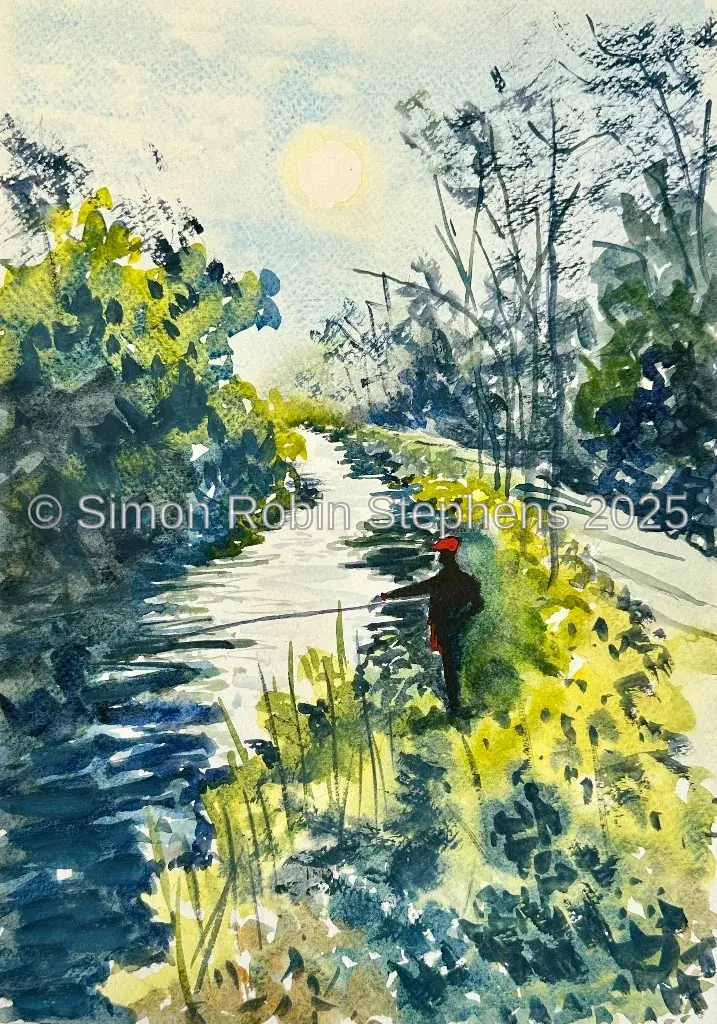
<p>One of my favourite uses of wet-on-wet is for atmospheric, non-specific backgrounds — the kind of soft suggestion of landscape or weather that provides context for a more detailed foreground. Wetting the entire sheet and applying large, loose washes of colour, allowing them to blend and move freely, produces a kind of painterly background that no amount of careful work could replicate. The key is to work quickly and resist the urge to fiddle once the paint is down.</p>
<p>This approach requires trusting the medium. The most interesting wet-on-wet backgrounds are the ones where water and pigment have been given the space to do something surprising. Over-managing the process — correcting, lifting, reworking — usually produces something flatter and less interesting than leaving the first pass alone.</p>
<h2>Paper Makes an Enormous Difference</h2>
<p>Wet-on-wet behaviour varies significantly between papers. Heavily sized papers (where the gelatine sizing is on the surface) resist the initial water application and give you more control — the paint stays near the surface and moves less freely. Softer, more absorbent papers (or papers with internal sizing) allow water to penetrate more quickly, producing faster-spreading, less controllable results.</p>
<p>For wet-on-wet work, I prefer 300gsm (140lb) hot-pressed or cold-pressed cotton paper that has been stretched or that is heavy enough to resist buckling. Arches, Fabriano Artistico, and Saunders Waterford are all reliable choices. Paper weight matters: lighter paper buckles when wet, creating hills and valleys that collect water and cause unpredictable pooling.</p>
<h2>Practice Makes the Timing Reliable</h2>
<p>The most useful thing I can say about wet-on-wet is this: the timing is learnable, but it cannot be learned without doing it. Watching wet paper dry and developing a reliable sense of what each stage looks and feels like takes deliberate practice. Set up a sheet of paper, wet it, and watch it — place paint at various stages and record what happens. Do this ten times and your instinct for timing will begin to develop. Do it a hundred times and it will become second nature.</p>
<p>This kind of deliberate, observational practice is different from simply painting. It is more like scientific observation — taking notes, asking what happened and why, developing understanding rather than just accumulating pictures. It is the fastest route to reliable control of a technique that rewards understanding.</p>
<p>If you would like to work on wet-on-wet technique in a supported setting, my <a href="/workshops">workshops in Carshalton</a> give beginner and intermediate painters the time and space to practice exactly this kind of foundational technique.</p>