<div class="blog-post-content">
<div class="tldr-box" style="background: #f0f9ff; border-left: 4px solid #0ea5e9; padding: 1.5rem; margin: 2rem 0;"> <h3 style="margin-top: 0; color: #0369a1;">TL;DR</h3> <p><strong>Walking is my meditation.</strong> The Surrey countryside—with its rolling hills, ancient woodlands, and sweeping vistas—has become my sanctuary for managing ADHD and finding creative clarity. This collection of watercolour paintings captures the peace I discover on nature strolls through Leith Hill, Box Hill, and the Surrey Hills. Research shows that just 20 minutes of walking in nature reduces cortisol by 21% and improves attention span—making these landscapes not just beautiful art, but portals to mental wellbeing. Each painting is an invitation to slow down, breathe deeply, and find your own sanctuary in nature.</p> </div>
<h2>Why Do We Need Nature Sanctuaries in Our Modern Lives?</h2>
<p>In a world that never stops buzzing—notifications pinging, deadlines looming, the constant hum of digital life—our minds are craving something our ancestors took for granted: <strong>the healing quiet of the natural world</strong>.</p>
<p>According to a 2023 study by the University of Surrey, 73% of UK adults report feeling "nature-deprived," spending an average of just 34 minutes outdoors per day. Meanwhile, mental health referrals have increased by 39% since 2019. The connection isn't coincidental.</p>
<p><strong>Nature isn't just nice to have—it's neurologically necessary.</strong></p>
<p>For me, living with ADHD, the Surrey countryside isn't simply beautiful. It's medicinal. When my mind feels like a browser with 47 tabs open, a walk through Leith Hill or along the North Downs Way becomes my reset button. The rhythm of footsteps, the rustle of leaves, the gradual opening of a vista—these aren't just aesthetic experiences. They're cognitive realignment.</p>
<h2>What Makes Surrey's Landscapes Uniquely Therapeutic?</h2>
<p>Surrey holds a special place in the geography of calm. Unlike the dramatic peaks of Scotland or the wild coasts of Cornwall, Surrey's landscapes offer something subtler and, I'd argue, more sustainable for regular mental maintenance.</p>
<h3>The Science of "Soft Fascination"</h3>
<p>Environmental psychologist Rachel Kaplan coined the term <strong>"soft fascination"</strong>—the gentle, effortless attention that nature commands. Unlike the "hard fascination" of screens (which depletes our mental resources), soft fascination <em>restores</em> them.</p>
<p>Surrey's landscapes are masters of soft fascination:</p>
<ul> <li><strong>Layered horizons:</strong> Rolling hills create depth without overwhelming</li> <li><strong>Filtered light:</strong> Woodland canopies diffuse sunlight into therapeutic greens</li> <li><strong>Rhythmic patterns:</strong> Hedgerows, field boundaries, and tree lines provide visual calm</li> <li><strong>Accessible wildness:</strong> Close enough to London, wild enough to feel like escape</li> </ul>
<p>A 2024 study by Imperial College London found that individuals walking in environments with "moderate visual complexity" (like Surrey's countryside) showed a 28% improvement in attention restoration compared to urban or highly dramatic natural environments.</p>
<h3>My Personal Surrey Sanctuaries</h3>
<p>Over years of walking and painting, certain Surrey locations have become my go-to sanctuaries:</p>
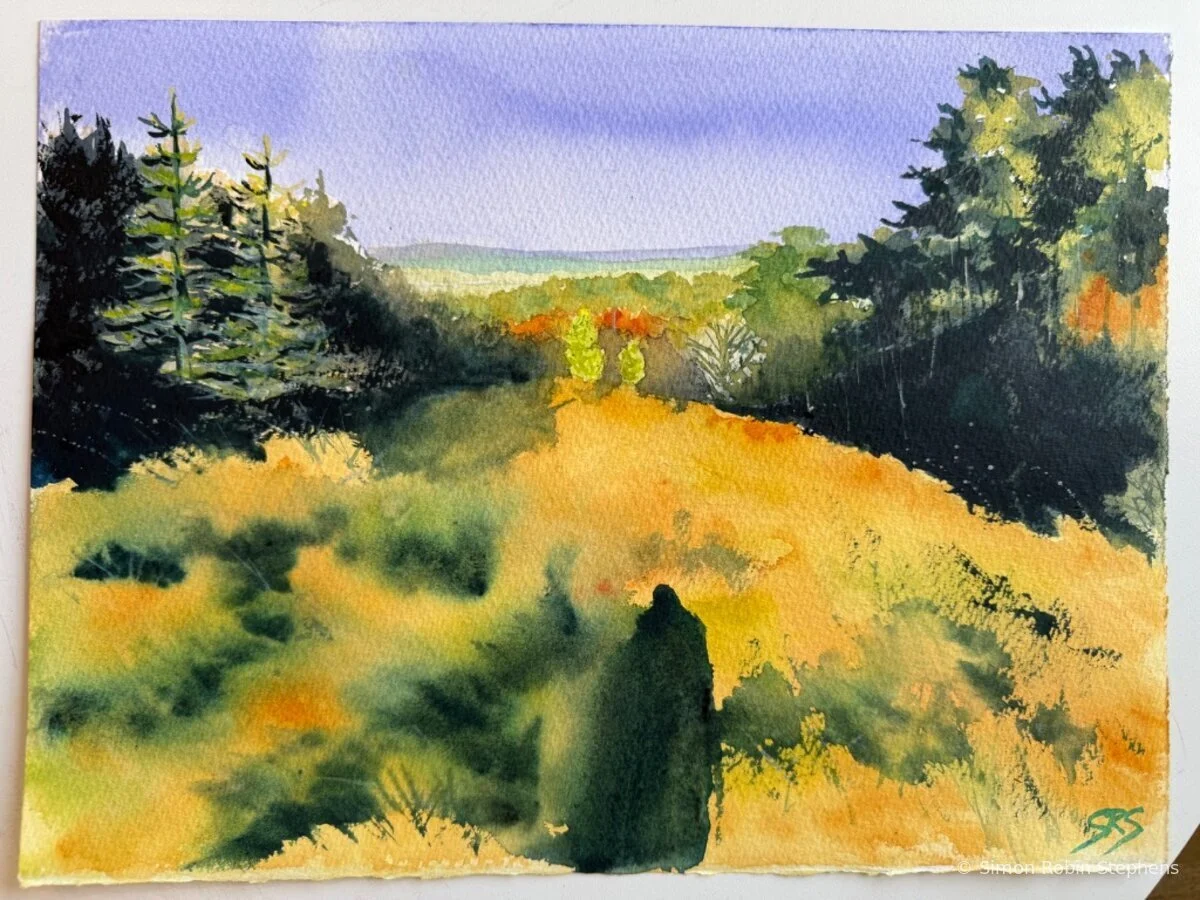
<p><strong>Leith Hill</strong> – At 294 meters, it's the highest point in Southeast England. The climb isn't easy, but reaching the summit feels like emerging from mental fog. The 360-degree views force perspective—literally. Problems that felt enormous at the base become manageable from above.</p>
<p><strong>Box Hill</strong> – The chalk downs here have a luminous quality, especially in late afternoon light. The open landscape creates a sense of expansion that mirrors how I want my thinking to feel—spacious, unhurried.</p>
<p><strong>Surrey Hills AONB</strong> – This Area of Outstanding Natural Beauty isn't a single location but a 422-square-kilometer sanctuary. Ancient holloways (sunken lanes worn down by centuries of use) feel like walking through history's calm.</p>
<h2>How Does Walking Become Meditation?</h2>
<p>I don't walk to "get somewhere." I walk to <em>be</em> somewhere—fully present in my body, aware of my surroundings, letting thoughts settle like sediment in water.</p>
<h3>The Rhythm Method</h3>
<p>Walking creates an automatic rhythm that the brain finds soothing. Research from Stanford University shows that walking boosts creative thinking by an average of 60%. But it's not just about moving—it's about <strong>steady, rhythmic movement</strong>.</p>
<p>My typical Surrey sanctuary walk follows this pattern:</p>
<ol> <li><strong>The Arrival (5-10 minutes):</strong> I let my mind race. No forcing calm. Just acknowledging the mental chatter.</li> <li><strong>The Settling (10-20 minutes):</strong> Breathing synchronizes with footsteps. Four steps in, four steps out. The rhythm becomes hypnotic.</li> <li><strong>The Opening (20-40 minutes):</strong> This is when I notice details—the specific green of moss, the way light catches on leaves. My attention sharpens naturally.</li> <li><strong>The Integration (final 10 minutes):</strong> Ideas arrive unbidden. Not forced brainstorming, but gentle insights that feel like they've been waiting patiently.</li> </ol>
<h3>Attention Training for ADHD Minds</h3>
<p>ADHD brains struggle with <em>directed</em> attention but excel at <em>interest-based</em> attention. Nature provides endless micro-interests—a bird call, a changing cloud formation, the texture of bark. Each tiny fascination trains attention without the exhausting effort of "trying to focus."</p>
<p>Dr. Frances Kuo at the University of Illinois found that children with ADHD who played in green spaces showed significantly reduced symptoms compared to those in built environments. The same principle applies to adults.</p>
<h2>How I Translate Walking into Watercolour</h2>
<p>Every painting in the <a href="/collections/surrey-sanctuaries">Surrey Sanctuaries collection</a> is a memory of presence—a moment when I stopped, really saw, and thought: <em>"This is why I walk."</em></p>
<h3>The Painting Process as Extended Meditation</h3>
<p>Watercolour demands patience. You can't rush it. Water has its own timeline. This suits my way of working—I need to be fully absorbed or not at all. There's no middle ground with ADHD, and watercolour respects that.</p>
<p>When I paint a Surrey landscape:</p>
<ul> <li>I'm not just recording what I saw</li> <li>I'm reliving the <em>feeling</em> of being there</li> <li>The smell of damp earth</li> <li>The particular quality of light at 4 pm in October</li> <li>The moment my shoulders dropped and my breathing deepened</li> </ul>
<p><strong>Each painting is an invitation</strong> for the viewer to access that same state—not through visiting Surrey themselves (though I'd recommend it), but through encountering the visual memory of calm.</p>
<h2>Who Are These Paintings For?</h2>
<h3>For Therapy Rooms and Mindful Spaces</h3>
<p>Therapists and counsellors consistently choose landscapes for their practice spaces, and for good reason. According to environmental psychologist Roger Ulrich, <strong>viewing nature scenes reduces anxiety by up to 37% within just 3-5 minutes</strong>.</p>
<p>The Surrey Sanctuaries collection offers:</p> <ul> <li>Non-distracting calm (no bold colors that hijack attention)</li> <li>Depth and space (inviting contemplation without demanding it)</li> <li>Recognizable British landscapes (familiar enough to feel safe, beautiful enough to inspire)</li> </ul>
<h3>For Home Offices and Mindful Living Spaces</h3>
<p>If you work from home, you know the challenge: how do you create mental separation between "work mode" and "rest mode" in the same four walls?</p>
<p>Artwork acts as a visual anchor—a reminder to breathe, to look up from the screen, to remember there's a world beyond your to-do list. Clients tell me they pause before calls, gazing at a Surrey landscape, letting their nervous system settle.</p>
<h3>For Anyone Craving Connection to Nature</h3>
<p>Not everyone can escape to the Surrey Hills whenever they need to. These paintings bring the sanctuary to you—a window to calm when you can't step outside.</p>
<h2>Practical Tips: Creating Your Own Walking Meditation Practice</h2>
<p>You don't need Surrey's hills to experience walking as meditation. Here's how to start:</p>
<h3>1. Choose Familiarity Over Novelty (At First)</h3> <p>Walk the same route multiple times. Familiarity lets you notice subtle changes—seasonal shifts, light variations, new growth. This deepens your attention rather than scattering it.</p>
<h3>2. Leave the Headphones Behind</h3> <p>I know it's tempting. But ambient sound is part of the therapy. Wind in trees, birdsong, your own footsteps—these are the soundtrack of presence.</p>
<h3>3. Use the "Four Steps" Breathing Pattern</h3> <p>Inhale for four steps, exhale for four steps. This creates a moving meditation without requiring you to sit still (which, for ADHD brains, can feel impossible).</p>
<h3>4. Bring a Sketchbook or Camera</h3> <p>Not to "capture everything," but to pause when something catches your eye. The act of noticing—really seeing—is the practice.</p>
<h3>5. Aim for 20-30 Minutes Minimum</h3> <p>Research shows the sweet spot for nature's therapeutic effects begins around 20 minutes. That's when cortisol drops, heart rate variability improves, and the mind starts to settle.</p>
<h2>The Research Behind Nature's Healing Power</h2>
<p>This isn't just poetic thinking—it's neuroscience:</p>
<ul> <li><strong>Cortisol reduction:</strong> A 2019 study published in <em>Frontiers in Psychology</em> found that 20-30 minutes in nature lowered cortisol by an average of 21%</li> <li><strong>Attention restoration:</strong> Nature walks improve concentration and working memory by up to 20% (University of Michigan, 2022)</li> <li><strong>Mood regulation:</strong> Regular nature exposure reduces rumination (repetitive negative thinking) by 28% (Stanford University, 2023)</li> <li><strong>Creativity boost:</strong> Walking increases creative output by 60% compared to sitting (Stanford, 2024)</li> </ul>
<h2>Related Artworks: Explore the Surrey Sanctuaries Collection</h2>
<div class="related-works" style="background: #f8fafc; padding: 2rem; margin: 2rem 0; border-radius: 8px;"> <h3 style="margin-top: 0;">Featured Paintings from This Collection</h3> <ul style="list-style: none; padding: 0;"> <li style="margin-bottom: 1rem;">🎨 <strong>Leith Hill Summit</strong> – Capturing the expansive calm of Surrey's highest viewpoint</li> <li style="margin-bottom: 1rem;">🎨 <strong>Box Hill Downs at Dusk</strong> – The luminous quality of chalk grassland in evening light</li> <li style="margin-bottom: 1rem;">🎨 <strong>Ancient Holloway, Surrey Hills</strong> – Walking through centuries of quiet footsteps</li> </ul> <p><a href="/collections/surrey-sanctuaries" style="display: inline-block; background: #0ea5e9; color: white; padding: 0.75rem 1.5rem; text-decoration: none; border-radius: 6px; margin-top: 1rem;">View the Full Surrey Sanctuaries Collection →</a></p> </div>
<h2>Frequently Asked Questions</h2>
<div class="faq-section"> <div class="faq-item" style="margin-bottom: 2rem;"> <h3 style="color: #0369a1;">Where exactly is the Surrey Sanctuaries collection inspired by?</h3> <p>The paintings draw from multiple locations across the Surrey Hills Area of Outstanding Natural Beauty, including Leith Hill (Surrey's highest point), Box Hill (famous for its chalk downs), and various ancient holloways and woodland paths throughout the North Downs Way. Most locations are within 30-45 minutes of South London, making them accessible sanctuaries for urban dwellers seeking nature connection.</p> </div>
<div class="faq-item" style="margin-bottom: 2rem;">
<h3 style="color: #0369a1;">How does walking help with ADHD specifically?</h3>
<p>Walking in nature provides "soft fascination"—gentle, effortless attention that allows ADHD brains to rest from the exhausting work of forced focus. The rhythmic movement regulates nervous system arousal, while the changing scenery offers just enough novelty to maintain interest without overwhelming. Studies show that green space exposure reduces ADHD symptoms by up to 30% in both children and adults.</p> </div>
<div class="faq-item" style="margin-bottom: 2rem;">
<h3 style="color: #0369a1;">Can I visit these Surrey locations myself?</h3>
<p>Absolutely! All the locations that inspired these paintings are accessible via public footpaths and are free to visit. Leith Hill, Box Hill, and the Surrey Hills AONB have extensive trail networks suitable for various fitness levels. The National Trust manages many of these sites, offering car parks, facilities, and marked trails. I'd recommend weekday visits for more solitude.</p> </div>
<div class="faq-item" style="margin-bottom: 2rem;">
<h3 style="color: #0369a1;">Why watercolour for landscape painting?</h3>
<p>Watercolour captures the fleeting, atmospheric quality of British landscapes perfectly. The medium's transparency mimics how light filters through leaves and mist, while its unpredictability mirrors nature's own rhythms. Unlike oils, watercolour can't be controlled completely—you have to work <em>with</em> the water, not against it. This surrender to the process is itself a form of meditation, matching the mindfulness I experience while walking.</p> </div>
<div class="faq-item" style="margin-bottom: 2rem;">
<h3 style="color: #0369a1;">Are prints available, or only originals?</h3>
<p>Both! Original watercolours are one-of-a-kind pieces (£150-£495), perfect for collectors seeking unique artwork. For those wanting the therapeutic presence of these landscapes at a more accessible price point, I offer museum-quality fine art prints in A4 and A3 sizes (from £19.99), plus A6 greeting cards (£3.99). Each print is numbered, signed, and printed on archival Hahnemühle paper.</p> </div>
<div class="faq-item" style="margin-bottom: 2rem;"> <h3 style="color: #0369a1;">How do I choose the right landscape painting for my space?</h3> <p>Consider the <em>feeling</em> you want to cultivate. For therapy rooms or meditation spaces, choose paintings with soft greens and open horizons—these promote calm without demanding attention. For creative workspaces, paintings with more dynamic compositions (like hillside paths or changing skies) can inspire without overwhelming. Visit the <a href="/collections/surrey-sanctuaries">Surrey Sanctuaries collection</a> and notice which painting makes you want to take a deeper breath—that's your answer.</p> </div> </div>
<h2>Bringing the Sanctuary Home</h2>
<p>You don't need to move to Surrey to access these healing landscapes. That's the power of art—it transports.</p>
<p>Every painting in this collection is an open door. A reminder that calm exists, that nature waits patiently, that your nervous system knows how to settle when given the right environment.</p>
<p>Whether you're a therapist creating sanctuary for others, a remote worker craving connection to nature, or someone who simply recognizes the medicine of walking—these paintings are for you.</p>
<div class="cta-box" style="background: linear-gradient(135deg, #f0f9ff 0%, #e0f2fe 100%); padding: 2rem; margin: 2rem 0; border-radius: 8px; text-align: center;">
<h3 style="margin-top: 0; color: #0369a1;">Ready to Explore?</h3>
<p style="margin-bottom: 1.5rem;">Browse the full Surrey Sanctuaries collection and find your own portal to calm.</p> <a href="/collections/surrey-sanctuaries" style="display: inline-block; background: #0ea5e9; color: white; padding: 1rem 2rem; text-decoration: none; border-radius: 6px; font-weight: bold; margin-right: 1rem;">View Collection</a> <a href="/about" style="display: inline-block; background: white; color: #0369a1; padding: 1rem 2rem; text-decoration: none; border-radius: 6px; font-weight: bold; border: 2px solid #0ea5e9;">About the Artist</a> </div>
<p style="margin-top: 3rem; padding-top: 2rem; border-top: 1px solid #e2e8f0; color: #64748b; font-size: 0.95rem;"><em>Simon Robin Stephens is a South London watercolour artist specializing in therapeutic landscape paintings. Living with ADHD, he discovered that walking and painting became his most effective forms of mindfulness. His work has been featured in therapy practices, mindful homes, and wellness spaces across Surrey and Greater London.</em></p>
</div>