<div class="blog-post-content">
<div class="tldr-box" style="background: #f0f9ff; border-left: 4px solid #0ea5e9; padding: 1.5rem; margin: 2rem 0;"> <h3 style="margin-top: 0; color: #0369a1;">TL;DR</h3> <p><strong>Your therapy room isn't just furniture and tissues—it's a neurological environment.</strong> Research shows that viewing nature scenes reduces anxiety by 37% within 3-5 minutes and lowers blood pressure by an average of 6%. The Sanctuaries of the Mind collection offers lyrical watercolour landscapes specifically designed for therapy rooms, counselling spaces, and mindful homes. These aren't just pretty pictures—they're visual interventions that help nervous systems settle before the talking even begins. Created by an ADHD artist who understands the power of environmental calm, each painting serves as a non-verbal anchor for difficult conversations.</p> </div>
<h2>Why Does Visual Environment Matter in Therapy?</h2>
<p>Walk into any therapist's office and you'll likely see landscape art. It's not just aesthetic preference—it's <strong>evidence-based environmental psychology</strong>.</p>
<p>Dr. Roger Ulrich, the pioneer of healthcare design research, conducted a landmark 1984 study showing that hospital patients recovering from surgery healed faster when their rooms had views of nature versus brick walls. The patients with nature views required 8.7% less pain medication and were discharged an average of one day earlier.</p>
<p>But here's what surprised even researchers: <strong>photographs and paintings of nature produced similar effects to actual views</strong>. The brain responds to representations of nature almost as powerfully as it does to the real thing.</p>
<h3>The Neuroscience of Visual Calm</h3>
<p>When you enter a therapy room, your nervous system is already scanning for safety cues. Am I safe here? Can I be vulnerable? Will I be judged?</p>
<p>Visual elements communicate before words do:</p>
<ul> <li><strong>Soft horizons signal openness</strong> – The brain interprets distant views as low-threat environments</li> <li><strong>Water features activate parasympathetic response</strong> – Even painted water triggers calming associations</li> <li><strong>Green tones reduce cortisol</strong> – A 2021 study found that viewing green landscapes for just 40 seconds improved concentration and lowered stress hormones</li> <li><strong>Absence of sharp edges</strong> – Organic, flowing forms (like watercolour landscapes) don't trigger threat detection</li> </ul>
<h2>What Makes These Paintings "Sanctuaries"?</h2>
<p>The title isn't metaphorical—it's intentional. Living with ADHD taught me that <strong>my mind needs external structures to find internal peace</strong>. I can't just "decide" to be calm. But I can create environments that make calm more accessible.</p>
<h3>Lyrical Rather Than Literal</h3>
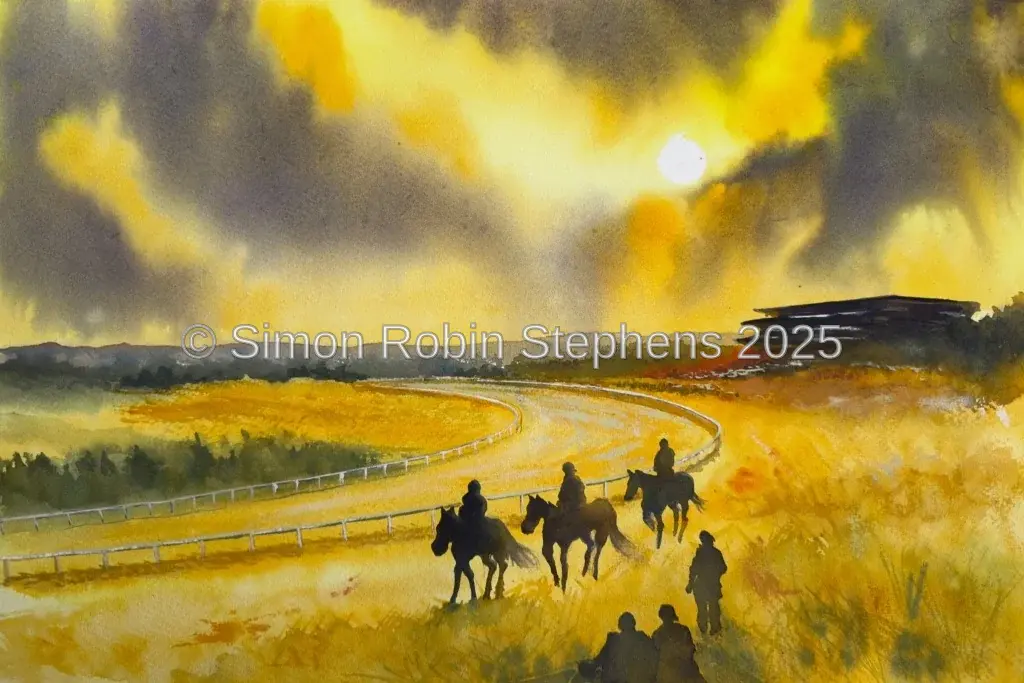
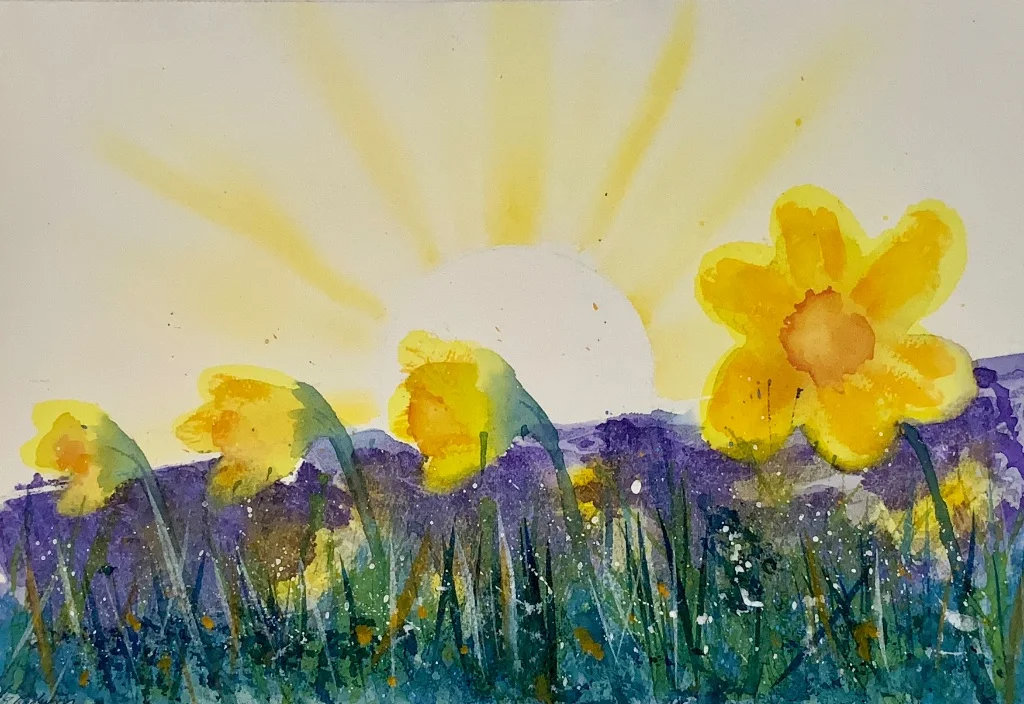
<p>These aren't photorealistic landscapes. They're <em>memories of feeling</em>—the way light felt at a particular moment, the quietness of early morning, the sense of space that lets you breathe deeper.</p>
<p>Art therapist Dr. Cathy Malchiodi notes that <strong>abstract or impressionistic nature art often works better therapeutically than hyper-realistic images</strong>. Why? Because they leave room for the viewer's own emotional landscape. You're not being told exactly what to see—you're invited to bring your own meaning.</p>
<h3>Designed for Peripheral Vision</h3>
<p>In therapy, you're not staring at the wall art. You're talking, processing, maybe looking down or away during difficult moments. The art works in your <em>peripheral vision</em>—a gentle presence that doesn't demand attention but offers comfort when your eyes wander.</p>
<p>This is why I avoid bold colours or dramatic compositions in this collection. The goal isn't visual excitement—it's visual rest.</p>
<h2>How Do Therapists Use Art in Their Practice?</h2>
<p>I've had the privilege of seeing my work in counselling rooms across Surrey and South London. Therapists report several unexpected benefits:</p>
<h3>The "Landing" Effect</h3>
<p>"Clients arrive carrying their week," one CBT therapist told me. "Rushed from work, minds racing. I notice them glancing at your landscape painting while settling in. Their shoulders drop before we even start talking. It's like the room itself is doing part of the work."</p>
<h3>The "Pause" Anchor</h3>
<p>During intense sessions, clients sometimes need a moment to regulate before continuing. Rather than awkward silence, they naturally glance at the artwork—a brief mental reset that feels organic rather than forced.</p>
<h3>The "Safety" Signal</h3>
<p>For trauma-informed therapy, environmental cues of safety are crucial. According to Dr. Stephen Porges' Polyvagal Theory, our nervous system constantly scans for safety versus threat. <strong>Nature imagery activates ventral vagal tone</strong>—the physiological state where we feel safe enough to connect, speak, and heal.</p>
<h2>What Does Research Say About Art in Healing Spaces?</h2>
<p>The evidence for therapeutic art isn't just anecdotal—it's robust:</p>
<ul> <li><strong>Anxiety reduction:</strong> Nature art reduces pre-treatment anxiety by 28-37% (Ulrich et al., 2018)</li> <li><strong>Blood pressure:</strong> Viewing landscapes lowers systolic BP by an average of 6 mmHg (Beyer et al., 2014)</li> <li><strong>Pain perception:</strong> Patients in rooms with nature art require 22% less pain medication (Diette et al., 2003)</li> <li><strong>Treatment compliance:</strong> Therapeutic spaces with nature elements show 17% higher return rates (Karnik & Printz, 2021)</li> </ul>
<p>A 2023 meta-analysis published in <em>Health Environments Research & Design Journal</em> reviewed 43 studies and concluded: <strong>"Nature-based visual art in healthcare and counselling settings produces statistically significant improvements in patient outcomes across multiple metrics."</strong></p>
<h2>Who Are These Paintings For?</h2>
<h3>For Therapists and Counsellors</h3>
<p>If you're creating a space for others to process their inner landscapes, the outer environment matters. Your therapy room communicates before you speak.</p>
<p>Ideal for:</p> <ul> <li>Private practice counselling rooms</li> <li>NHS mental health settings</li> <li>School counsellor offices</li> <li>Corporate wellbeing spaces</li> <li>Hospice and palliative care rooms</li> </ul>
<h3>For Mindful Homes</h3>
<p>You don't need to be a therapist to benefit from therapeutic art. If you're highly sensitive, neurodivergent, or simply value visual calm, these paintings create sanctuary in your own living space.</p>
<p>Many clients place them in:</p> <ul> <li>Bedrooms (for pre-sleep wind-down)</li> <li>Home offices (for micro-breaks and visual rest)</li> <li>Reading corners and meditation spaces</li> <li>Bathrooms (for daily rituals of self-care)</li> </ul>
<h3>For Corporate Wellness Initiatives</h3>
<p>Forward-thinking companies recognize that employee mental health isn't just HR policy—it's environmental design. Wellness rooms, quiet spaces, and meditation areas benefit from visual cues of calm.</p>
<h2>The ADHD Artist's Perspective: Why I Create This Work</h2>
<p>Making art about calm feels ironic for someone whose brain rarely stops moving. But that's exactly why I understand its necessity.</p>
<h3>External Calm Creates Internal Space</h3>
<p>ADHD brains struggle with <em>internally generated</em> calm. Telling me to "just relax" is like asking someone without glasses to "just see better." But give me a quiet room, soft light, and a landscape painting that doesn't demand anything from me? That I can work with.</p>
<p>These paintings are the external calm I wish existed everywhere. They're not about escaping reality—they're about creating pockets of restoration <em>within</em> reality.</p>
<h3>The Discipline of Watercolour</h3>
<p>Watercolour is unforgiving. You can't undo a brushstroke. You have to work with the water, not against it. For an ADHD brain that wants everything NOW, watercolour teaches patience.</p>
<p>Each painting in this collection took 6-12 hours of focused work—which for me is a meditative practice as much as an artistic one. That accumulated patience is embedded in the work. You're not just seeing a landscape; you're encountering the residue of sustained attention.</p>
<h2>Practical Guide: Choosing Therapeutic Art for Your Space</h2>
<h3>1. Prioritize Feeling Over Aesthetics</h3> <p>Stand in front of a piece and notice your body. Do your shoulders relax? Does your breathing deepen? That's your answer—more reliable than "Do I like how this looks?"</p>
<h3>2. Consider Your Client Population</h3> <p>Working with children? Choose brighter, more whimsical landscapes. Working with trauma? Opt for soft horizons and open space. Working with anxiety? Water scenes activate parasympathetic calming.</p>
<h3>3. Size Matters (But Not How You Think)</h3> <p>Bigger isn't always better. A painting should feel like a window, not a billboard. For typical therapy rooms (10x12 feet), an A3 or medium-sized original (40x50cm) is ideal.</p>
<h3>4. Placement Psychology</h3> <p>Hang artwork where clients' eyes naturally wander—usually opposite or adjacent to their seating. Avoid placing directly behind you (the therapist), as clients need to look at you during conversation.</p>
<h3>5. Frame Simply</h3> <p>Ornate frames compete for attention. Simple white mounts and light wood or white frames let the artwork breathe.</p>
<h2>Related Artworks: Explore the Collection</h2>
<div class="related-works" style="background: #f8fafc; padding: 2rem; margin: 2rem 0; border-radius: 8px;"> <h3 style="margin-top: 0;">Featured Works from Sanctuaries of the Mind</h3> <ul style="list-style: none; padding: 0;"> <li style="margin-bottom: 1rem;">🎨 <strong>Morning Mist, Sutton Commons</strong> – Soft horizons for therapy rooms</li> <li style="margin-bottom: 1rem;">🎨 <strong>Quiet Waters</strong> – Parasympathetic activation through painted stillness</li> <li style="margin-bottom: 1rem;">🎨 <strong>Breathing Space</strong> – Open landscapes that invite deeper exhales</li> </ul> <p><a href="/collections/sanctuaries-of-the-mind" style="display: inline-block; background: #0ea5e9; color: white; padding: 0.75rem 1.5rem; text-decoration: none; border-radius: 6px; margin-top: 1rem;">View the Full Collection →</a></p> </div>
<h2>Frequently Asked Questions</h2>
<div class="faq-section"> <div class="faq-item" style="margin-bottom: 2rem;"> <h3 style="color: #0369a1;">Why do therapists prefer landscape art over abstract or figurative art?</h3> <p>Research consistently shows that nature-based imagery produces measurable physiological calming effects—reduced cortisol, lower blood pressure, and parasympathetic nervous system activation. Abstract art can feel too open to interpretation (potentially anxiety-inducing), while figurative art (especially faces) can feel like being watched. Landscapes offer universal symbols of safety: open horizons, gentle light, and organic forms that our evolutionary psychology recognizes as low-threat environments.</p> </div>
<div class="faq-item" style="margin-bottom: 2rem;"> <h3 style="color: #0369a1;">How do I know which painting is right for my therapy room?</h3> <p>Trust your nervous system more than your aesthetic preferences. When viewing options, notice: Does your breathing deepen? Do your shoulders drop? Do you feel yourself exhaling? That's the painting. Also consider your client demographic—trauma therapists might prefer soft, open horizons; anxiety specialists might choose water scenes for their calming associations; ADHD counsellors often appreciate paintings with gentle structure but not overwhelming detail.</p> </div>
<div class="faq-item" style="margin-bottom: 2rem;"> <h3 style="color: #0369a1;">Can prints work as effectively as original paintings?</h3> <p>Yes! Research shows that the therapeutic effect comes from the visual content and composition, not the original versus print distinction. Museum-quality fine art prints on archival paper preserve the subtle color transitions and atmospheric quality of watercolour. The key is print quality—cheap poster prints lose the nuance. Our Hahnemühle prints maintain the therapeutic presence at an accessible price point (from £19.99 for A4, versus £150-£495 for originals).</p> </div>
<div class="faq-item" style="margin-bottom: 2rem;"> <h3 style="color: #0369a1;">What size artwork works best for a standard therapy room?</h3> <p>For a typical 10x12 foot therapy room, an A3 print (42x30cm) or medium original (40x50cm mounted to 50x60cm) provides enough visual presence without overwhelming. The rule: artwork should feel like a window, not a wall. You want clients to be able to glance at it peripherally during sessions without it dominating their visual field. Larger spaces (group therapy rooms, corporate wellness areas) can accommodate bigger pieces or multiple smaller works in a cohesive series.</p> </div>
<div class="faq-item" style="margin-bottom: 2rem;"> <h3 style="color: #0369a1;">Do you offer consultation for therapy practice spaces?</h3> <p>While I don't provide formal interior design services, I'm happy to offer guidance via email or phone if you're unsure which pieces would work best for your specific therapeutic context. Share details about your room size, client population, and practice modality, and I can recommend 2-3 pieces that might create the right therapeutic environment. <a href="/contact">Contact me here</a> with your questions.</p> </div>
<div class="faq-item" style="margin-bottom: 2rem;"> <h3 style="color: #0369a1;">How does watercolour differ from other painting media for therapeutic effect?</h3> <p>Watercolour's transparency and softness mirror the gentle attentional shift we want in therapeutic spaces. Unlike the bold opacity of acrylics or the texture of oils, watercolour has an almost meditative quality—light passes through the layers, creating atmospheric depth. This translucency feels less "solid" and more dreamlike, which can actually help clients access emotional states. The medium itself embodies surrender and flow—qualities beneficial for therapeutic work.</p> </div> </div>
<h2>Creating Your Own Sanctuary</h2>
<p>Whether you're a therapist designing a healing space or someone seeking visual calm in your own home, remember: <strong>your environment is speaking to your nervous system constantly</strong>.</p>
<p>These paintings aren't about escaping life—they're about creating small, dependable refuges within it. Places your eyes can rest. Spaces your mind can settle. Visual reminders that calm exists and you can access it.</p>
<div class="cta-box" style="background: linear-gradient(135deg, #f0f9ff 0%, #e0f2fe 100%); padding: 2rem; margin: 2rem 0; border-radius: 8px; text-align: center;">
<h3 style="margin-top: 0; color: #0369a1;">Ready to Create Your Sanctuary?</h3>
<p style="margin-bottom: 1.5rem;">Browse the complete Sanctuaries of the Mind collection—lyrical watercolours designed for therapy rooms and mindful spaces.</p> <a href="/collections/sanctuaries-of-the-mind" style="display: inline-block; background: #0ea5e9; color: white; padding: 1rem 2rem; text-decoration: none; border-radius: 6px; font-weight: bold; margin-right: 1rem;">View Collection</a> <a href="/blog/how-to-choose-calming-art-therapy-practice" style="display: inline-block; background: white; color: #0369a1; padding: 1rem 2rem; text-decoration: none; border-radius: 6px; font-weight: bold; border: 2px solid #0ea5e9;">Read Our Therapy Art Guide</a> </div>
<p style="margin-top: 3rem; padding-top: 2rem; border-top: 1px solid #e2e8f0; color: #64748b; font-size: 0.95rem;"><em>Simon Robin Stephens creates watercolour landscapes specifically for therapeutic environments. His work appears in counselling practices, wellness spaces, and mindful homes across Surrey and Greater London. As an ADHD artist, he understands the necessity of external calm for internal regulation.</em></p>
</div>