<p>There is a particular kind of overwhelm that comes with ADHD. It is not always the dramatic kind — the missed deadlines, the lost keys, the conversations derailed mid-sentence. Sometimes it is subtler: a low-level static that hums behind everything, a sense of being too full, too fast, too much.</p>
<p>Over the years, I have learned that the quickest way to reset is not to try harder or push through. It is to go somewhere that is genuinely still. And in South London, where I live and work, that almost always means heading into Surrey.</p>
<p>These five places have become part of how I manage my own mind. I paint them not just because they are beautiful — though they are — but because something about them does something to my nervous system that I cannot fully explain but deeply trust.</p>
<h2>1. Buckland Lake, near Reigate</h2>
<p>Buckland Lake is the one I return to most often. It sits in a shallow valley in the Surrey Hills, surrounded by ancient oak woodland, and on a still morning the water is a near-perfect mirror. There is something about standing at its edge that immediately slows my breathing.</p>
<p>When I painted <em>Buckland Lake</em>, I spent a long time just looking before I picked up a brush. The quality of light there — diffuse, even, grey-green in autumn — does not demand anything of you. You can just be in it.</p>
<p>If you have ADHD and have never tried sitting quietly by a lake with nothing to do, I recommend it. Not because it is easy — it is not, at first. The restlessness arrives almost immediately. But if you stay with it, something happens. The water does the work.</p>
<blockquote><em>"The quality of light at Buckland Lake does not demand anything of you. You can just be in it."</em></blockquote>
<h2>2. Box Hill, at dusk</h2>
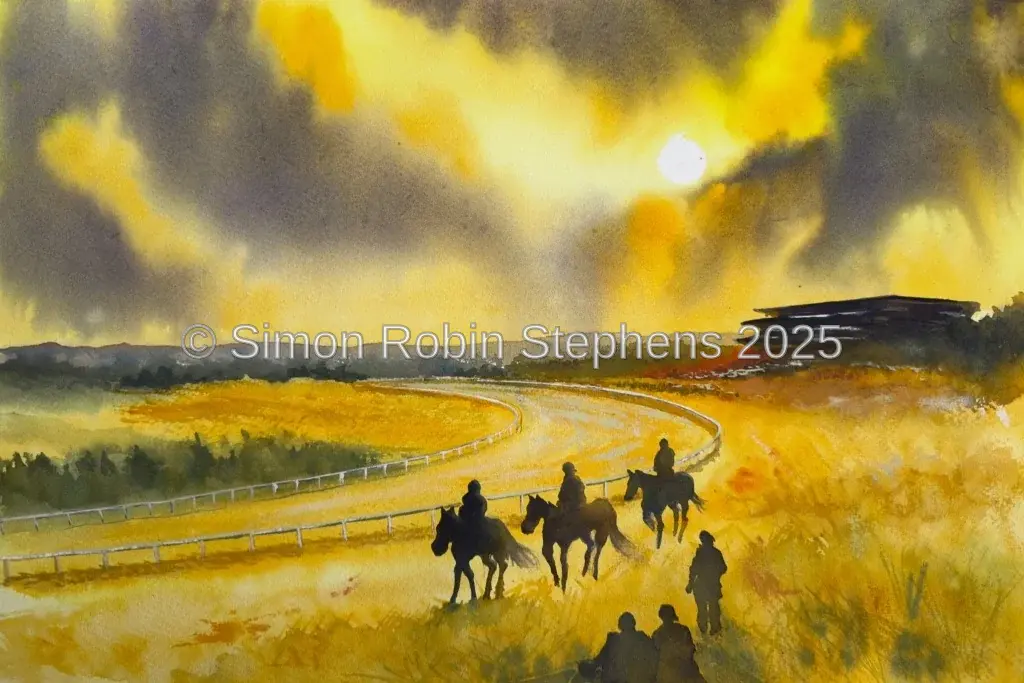
<p>Box Hill is probably the most visited viewpoint in Surrey. Which is why I go there at dusk, when almost everyone has left and the Mole Valley below fills with a warm low light that turns the chalk grassland gold.</p>
<p>The elevation helps. There is a physiological component to standing on high ground that I notice every time: shoulders drop, breathing deepens, the sense of being hemmed in dissolves. For a brain that often feels too close to everything, height creates necessary perspective.</p>
<p>I have painted Box Hill three times and each painting is a different mood. One is brooding and purple-blue, painted from memory after a winter walk. One is golden and almost impressionistic. The act of painting the same place across different seasons is, I think, a form of paying close attention — which is itself therapeutic for ADHD, because it gives the restless attention somewhere specific to go.</p>
<h2>3. The River Wey at Guildford</h2>
<p>Moving water is different from still water. Buckland Lake is for stopping. The Wey is for walking.</p>
<p>The towpath from Guildford towards Shalford follows the river through water meadows that feel remarkably unchanged from how they must have appeared a hundred years ago. In spring the banks are thick with cow parsley and the willows trail in the current. In winter the floods come and the fields turn briefly to lake.</p>
<p>What I love about river walking for ADHD is that there is always something new — a kingfisher, a heron, the angle of the light changing as the path bends — so the attention does not have to manufacture stimulation. The river provides it, gently, in a rhythm that matches the rhythm of walking.</p>
<p>I am working on a painting of the Wey in flood, which I hope to complete for the summer. The challenge is painting water that is moving without it looking frantic. Getting it right has required a kind of patience I am still building.</p>
<h2>4. Leith Hill, the highest point in southeast England</h2>
<p>At 294 metres, Leith Hill gives you the sea. On a clear day you can see the English Channel from its tower — a fact that never stops feeling extraordinary when you are standing there.</p>
<p>But what I love about Leith Hill is not the grand view. It is the forest on the way up. The National Trust woodland here is old and varied: ancient heathland, dense rhododendron corridors, open beech glades where the floor is a continuous carpet of copper leaves in autumn. The walk up is long enough to shift something in the body. By the time you reach the top, you have done something.</p>
<p>There is a painting in my gallery from this location — <em>Leith Hill Light</em> — which I painted largely from the emotion of the ascent rather than a specific view. The grey-greens and dusty purples in it are the colours of that particular exhaustion-that-feels-like-rest that ADHD brains often need.</p>
<h2>5. The North Downs Way, near Merstham</h2>
<p>The least spectacular of the five, in some ways. The North Downs near Merstham are not dramatic. The chalk escarpment is modest, the views are partly obstructed by trees, and the path passes uncomfortably close to the M25 motorway for a stretch.</p>
<p>And yet I keep going back.</p>
<p>I think it is the quality of the sky there. The North Downs are high enough that the sky becomes a significant part of the landscape — a changing, moving, enormous thing that makes the constant hum of the motorway seem, paradoxically, small. On a cloudy day the light shifts every few minutes. As a watercolourist who paints the sky a lot, this is a kind of endlessly renewable subject.</p>
<p>I also like that it is accessible. Merstham is twenty-five minutes from Victoria by train. You can be on the Downs within forty minutes of leaving central London. For those days when the ADHD overwhelm arrives suddenly and the need for space is urgent, this proximity matters.</p>
<h2>Why I paint these places, not just visit them</h2>
<p>Visiting these landscapes is restorative. Painting them is something else again.</p>
<p>When you paint a place, you must look at it far more carefully than you do when you simply walk through it. You have to decide: what is the light actually doing? Where does the shadow fall? What colour is that grey? This kind of close, slow attention is deeply counter to how ADHD usually works — and I think that is precisely why it helps.</p>
<p>It is effortful attention rather than forced attention. The difference matters. Forced attention — sitting at a desk trying to concentrate — feels like holding a door closed against wind. Effortful attention in a landscape you love feels like choosing to carry something you actually want to carry.</p>
<p>If you are interested in trying watercolour landscape painting yourself, I run small-group workshops from the Salvation Army Community Centre in Carshalton. They are deliberately slow-paced and no previous experience is needed. Several of my regular workshop participants describe them as the most relaxed three hours of their week.</p>
<p>And if one of these Surrey locations speaks to you, I am always open to <a href="/commission">commission work</a> — painting a specific place that has meaning for you. That is some of my most satisfying work.</p>
<p>For now, I am off to Buckland Lake.</p>