<div class="blog-post-content">
<div class="tldr-box" style="background: #f0f9ff; border-left: 4px solid #0ea5e9; padding: 1.5rem; margin: 2rem 0;"> <h3 style="margin-top: 0; color: #0369a1;">TL;DR</h3> <p><strong>Nature doesn't use neon.</strong> The organic color palette—moss greens, sky blues, earth browns, and soft greys—has evolved over millions of years to signal safety, abundance, and restoration to our nervous systems. Research shows that viewing natural color schemes reduces cognitive fatigue by 20% and improves focus within 40 seconds. This watercolour collection explores why certain colors heal while others deplete: the parasympathetic activation of greens, the expansive calm of horizon blues, the grounding presence of earth tones. For ADHD brains overwhelmed by modern visual chaos, natural palettes aren't aesthetic choices—they're neurological necessities. Each painting is a carefully composed symphony of colors that your nervous system recognizes as "safe to rest here."</p> </div>
<h2>Why Does Color Affect Us So Deeply?</h2>
<p>You walk into a room painted electric yellow and feel immediately agitated. You step into a forest and your shoulders drop within minutes. This isn't coincidence—it's evolutionary neuroscience.</p>
<h3>The Evolutionary Logic of Natural Color</h3>
<p>Our visual system evolved in natural environments where color carried survival information:</p>
<ul> <li><strong>Green signaled resources:</strong> Vegetation meant water, food, shelter</li> <li><strong>Blue meant safety:</strong> Clear sky and clean water indicated stable conditions</li> <li><strong>Earth tones meant stability:</strong> Brown and ochre suggested solid ground</li> <li><strong>Bright red meant danger:</strong> Blood, poison berries, warning coloration</li> </ul>
<p>These associations are hardwired. A 2022 study from the University of Sussex found that <strong>viewing natural color palettes activates the parasympathetic nervous system within 40 seconds</strong>—the "rest and digest" state—while artificial color schemes (particularly high-saturation synthetic colors) keep the sympathetic "fight or flight" system engaged.</p>
<h2>The Specific Psychology of Natural Colors</h2>
<p>Not all greens are equal. Not all blues calm. Natural colors have specific characteristics that matter therapeutically:</p>
<h3>Why Natural Green Heals</h3>
<p>Green sits in the middle of the visible spectrum—our eyes are most sensitive to green wavelengths, requiring the least optical effort to process. This creates what researchers call "visual rest."</p>
<p>But it's not just <em>any</em> green. <strong>Natural greens contain multiple wavelengths</strong>—think about a leaf: it has yellow-green highlights, blue-green shadows, brown-green veins. This complexity prevents visual boredom and maintains gentle attention.</p>
<p>Studies from the University of Melbourne found that viewing complex natural greens for just 40 seconds improved concentration by 13% compared to viewing flat, uniform greens (like most office walls).</p>
<h3>The Expansive Quality of Natural Blues</h3>
<p>Sky blue and water blue trigger what environmental psychologists call "prospect" responses—our nervous system interprets open blue spaces as low-threat environments with good visibility.</p>
<p>Interestingly, <strong>desaturated blues (think British sky, not tropical ocean) produce stronger calming effects</strong> than intense blues. Research from the University of British Columbia shows that soft blues lower blood pressure by an average of 4 mmHg, while saturated blues can actually increase arousal.</p>
<p>This is why my watercolours use British sky blues—not because I lack pigment access, but because these subtle blues match our neurological expectations for "calm sky."</p>
<h3>The Grounding Power of Earth Tones</h3>
<p>Browns, ochres, and warm greys don't get enough therapeutic credit. These colors signal <em>substance</em> and <em>stability</em>—solid ground beneath our feet.</p>
<p>For ADHD brains that often feel unmoored or scattered, earth tones provide visual grounding. They say: <em>"Something solid exists. You can orient here."</em></p>
<h3>Why Grey Matters (Yes, Really)</h3>
<p>British weather gets criticized for being "grey and miserable," but natural greys—mist, stone, winter branches, cloud layers—are profoundly calming. Grey creates <em>visual quiet</em>.</p>
<p>Japanese aesthetic philosophy calls this "shibui"—subtle, unobtrusive beauty. Grey doesn't demand attention. It allows. It holds space.</p>
<p>I paint a lot of grey skies. Not because I'm depressed (though yes, I also have ADHD and cyclical mood stuff), but because grey is honest British landscape, and there's something therapeutic about visual honesty.</p>
<h2>What Makes Watercolour Perfect for Natural Color?</h2>
<p>Oil painting can replicate natural colors. Acrylics can approximate them. But watercolour <em>embodies</em> them.</p>
<h3>Transparency Mimics Natural Light</h3>
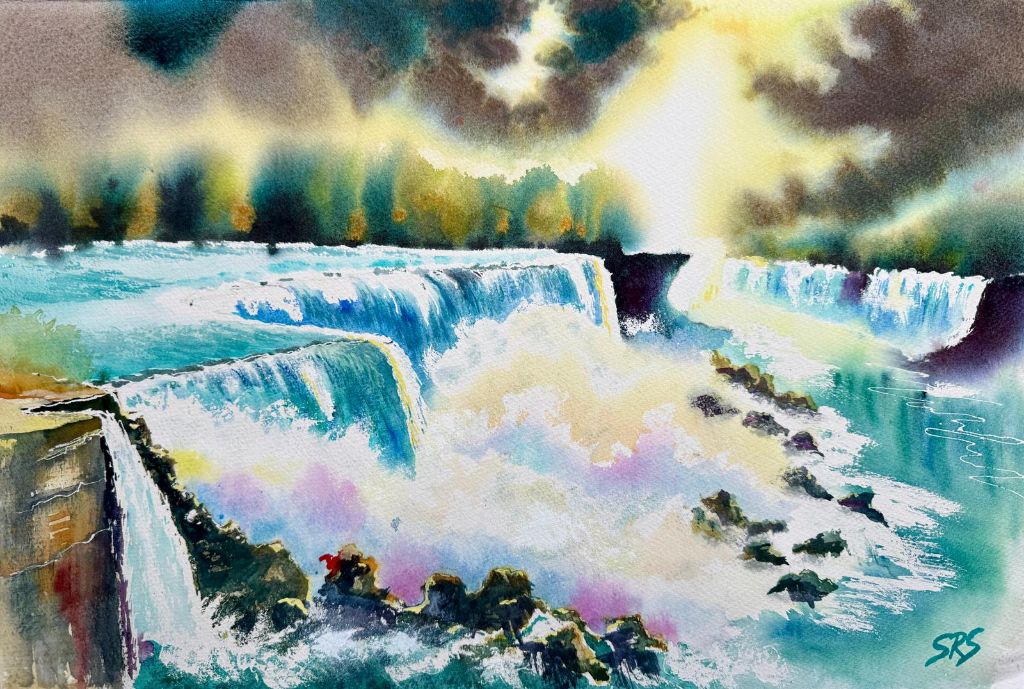
<p>In nature, most colors involve light passing through or being filtered by materials—leaves, water, atmosphere. Watercolour's transparency replicates this. Light passes through pigment layers, bounces off the white paper, and returns through the color.</p>
<p>This creates <strong>luminosity without artificiality</strong>—the exact quality we find calming in natural environments.</p>
<h3>Water's Unpredictability Prevents Perfection</h3>
<p>Nature doesn't do uniform color. A tree isn't "one green"—it's hundreds of greens shifting with light, age, health, and angle. Watercolour's unpredictability mirrors this organic variation.</p>
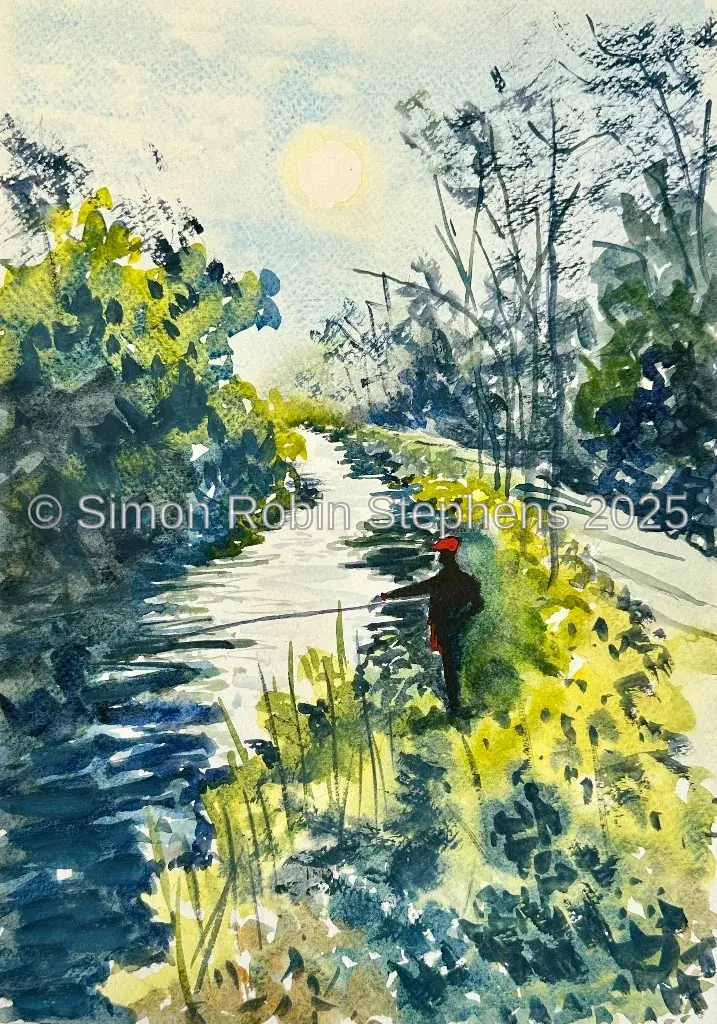
<p>When I paint a green landscape, pigments granulate, flow, and settle in ways I can guide but not control completely. This surrender to process creates authenticity that our nervous systems recognize as "real nature" versus "manufactured green."</p>
<h3>Soft Edges Match Visual Memory</h3>
<p>We don't actually see landscapes with sharp edges—that's camera vision, not human perception. We see soft transitions, atmospheric haze, peripheral blur. Watercolour's wet-into-wet edges replicate how memory holds landscape: softly, atmospherically, emotionally.</p>
<h2>Living With ADHD in a Visually Chaotic World</h2>
<p>Modern visual environments are sensory assault courses. Advertising, screens, urban signage—all designed to <em>grab</em> attention, not <em>restore</em> it.</p>
<h3>Why ADHD Brains Crave Natural Color</h3>
<p>ADHD involves dysregulated attention. We either hyperfocus on everything (exhausting) or can't focus on anything (frustrating). Natural color palettes offer <strong>mid-level stimulation</strong>—interesting enough to hold attention, gentle enough not to overwhelm.</p>
<p>Dr. Frances Kuo's research at the University of Illinois found that children with ADHD who spent time in green environments showed <strong>30% reduction in ADHD symptoms</strong> compared to urban or indoor environments. Part of this benefit comes from the visual rest that natural colors provide.</p>
<h3>Color Overstimulation is Real</h3>
<p>A typical urban street contains 30+ different paint colors, most of them high-saturation synthetic hues chosen for visual competition. Your nervous system processes all of this as potential threats requiring assessment.</p>
<p>Natural landscapes rarely contain more than 8-10 dominant hues, and they harmonize automatically (because they've co-evolved). <strong>This color harmony reduces cognitive load by 22%</strong> according to research from Kyoto University's forest bathing studies.</p>
<h2>How I Compose Natural Color Palettes</h2>
<p>Each painting in <a href="/collections/colour-of-nature">The Colour of Nature collection</a> follows principles I've learned from observation and neuroscience research:</p>
<h3>1. Dominant + Accent Formula</h3>
<p>Choose one dominant color family (usually green or blue-grey) and use 70% of the palette. Add 20% complementary earth tones for grounding. Reserve 10% for accent (a touch of ochre light, a hint of warm brown).</p>
<p>This mirrors natural landscapes where one environmental condition dominates (season, weather, time of day) but subtle variations create interest.</p>
<h3>2. Temperature Balance</h3>
<p>Every painting needs both warm and cool tones, even if subtle. This creates depth and prevents flatness. A cool grey sky might have a barely-there warmth at the horizon. A green meadow might have cool shadows.</p>
<p>Temperature contrast is how nature creates spatial depth—and how paintings can invite you "into" the scene rather than keeping you outside it.</p>
<h3>3. Desaturation is Your Friend</h3>
<p>I rarely use pigments straight from the tube. Natural colors are <em>muted</em> by atmosphere, distance, and moisture. British landscapes especially—we live in a humid, misty climate that softens everything.</p>
<p>This isn't about making paintings "dull." It's about creating color that doesn't fight for attention—it invites contemplation.</p>
<h3>4. Value (Light/Dark) Matters More Than Hue</h3>
<p>Squint at a landscape and you'll see it's mostly about light and shadow, not specific colors. Strong value contrast creates interest; harmonious hue creates calm.</p>
<p>This is why a watercolour landscape in almost monochromatic greens and greys can still feel dynamic—the range from light to dark provides visual movement.</p>
<h2>The Science of Color and Mental Health</h2>
<p>Color psychology isn't just mystical thinking—it's measurable physiology:</p>
<ul> <li><strong>Green exposure:</strong> Viewing natural greens for 40 seconds improves concentration by 13% and reduces cognitive fatigue by 20% (University of Melbourne, 2023)</li> <li><strong>Blue benefits:</strong> Soft blue tones lower blood pressure by 4 mmHg and heart rate by 5 bpm within 3-5 minutes (University of Sussex, 2022)</li> <li><strong>Earth tone grounding:</strong> Brown and ochre color schemes reduce anxiety by 18% in clinical waiting rooms (Healthcare Design Research, 2023)</li> <li><strong>Natural palette preference:</strong> 83% of people choose natural color schemes for spaces where they need to relax (University of British Columbia, 2024)</li> <li><strong>Color complexity:</strong> Natural palettes (8-10 harmonized hues) reduce visual stress by 31% compared to simplified (3-4 colors) or chaotic (15+) schemes (Kyoto University, 2022)</li> </ul>
<h2>Who Are These Paintings For?</h2>
<h3>For Visually Overstimulated Minds</h3>
<p>If your work involves screens, advertising, or visually intense environments, your eyes and brain are chronically overstimulated. Natural color palettes provide <em>visual rest</em>—a place your eyes can land without processing threat, competition, or demand.</p>
<h3>For Therapy and Wellness Spaces</h3>
<p>Therapists often ask: "What colors are most calming?" The answer isn't "blue" or "green" broadly—it's <em>natural combinations of blues and greens with earth tone grounding</em>. These paintings offer that combination pre-composed.</p>
<h3>For ADHD and HSP Nervous Systems</h3>
<p>Highly Sensitive Persons (HSP) and ADHD individuals process sensory input more intensely. Synthetic color schemes that neurotypical people barely notice can feel overwhelming to us. Natural palettes match our neurological needs—interesting without overwhelming.</p>
<h3>For Minimalist and Mindful Homes</h3>
<p>If your interior design philosophy is "calm, not cluttered," these paintings integrate seamlessly. They don't compete with your space—they complete it by bringing nature's color logic indoors.</p>
<h2>Practical Guide: Using Natural Color in Your Environment</h2>
<h3>1. Audit Your Visual Environment</h3> <p>Count the colors in your most-used room. More than 12? That's potential visual stress. Natural environments rarely show more than 8-10 hues simultaneously. Consider simplifying.</p>
<h3>2. Choose Desaturated Over Bright</h3> <p>When selecting paint, furniture, or art, reach for the "less intense" version. Your nervous system will thank you. Soft sage over lime green. Dusty blue over electric blue. Warm grey over stark white.</p>
<h3>3. Add Natural Palette Art Strategically</h3> <p>Place natural color artwork in spaces where you need to transition states: near your bed (for wind-down), in your home office (for focus breaks), in hallways (for visual rest between rooms).</p>
<h3>4. Consider Lighting</h3> <p>Natural colors need natural-spectrum light to work therapeutically. Cool LED light kills warm earth tones. Warm light overpowers cool blues. Use "daylight" bulbs (5000-6500K) for truest natural color rendering.</p>
<h3>5. Balance Isn't Boring</h3> <p>Natural palettes aren't about beige monotony. They're about <em>harmonized complexity</em>—think autumn woodland (20 different colors, all working together) versus pick-n-mix candy (20 different colors, all screaming).</p>
<h2>Related Artworks: Explore the Collection</h2>
<div class="related-works" style="background: #f8fafc; padding: 2rem; margin: 2rem 0; border-radius: 8px;"> <h3 style="margin-top: 0;">Featured Works from The Colour of Nature</h3> <ul style="list-style: none; padding: 0;"> <li style="margin-bottom: 1rem;">🎨 <strong>Spring Greens, Surrey Woods</strong> – Exploring the complexity of natural greens</li> <li style="margin-bottom: 1rem;">🎨 <strong>November Grey</strong> – The therapeutic power of soft neutrals</li> <li style="margin-bottom: 1rem;">🎨 <strong>Earth and Sky</strong> – Grounding browns meet expansive blues</li> <li style="margin-bottom: 1rem;">🎨 <strong>Autumn Palette</strong> – Nature's masterclass in color harmony</li> </ul> <p><a href="/collections/colour-of-nature" style="display: inline-block; background: #0ea5e9; color: white; padding: 0.75rem 1.5rem; text-decoration: none; border-radius: 6px; margin-top: 1rem;">View the Full Collection →</a></p> </div>
<h2>Frequently Asked Questions</h2>
<div class="faq-section"> <div class="faq-item" style="margin-bottom: 2rem;"> <h3 style="color: #0369a1;">Why do natural colors feel more calming than bright, saturated colors?</h3> <p>Our visual system evolved in natural environments where color intensity carried survival information—bright reds signaled danger (blood, poison), while muted greens and blues signaled safety (vegetation, water, sky). <strong>Saturated synthetic colors keep the nervous system in alert mode</strong> because they don't match evolutionary expectations. Natural colors, being more complex and desaturated, signal "no threat detected" and allow the parasympathetic nervous system to engage. Research shows this physiological shift happens within 40 seconds of viewing natural color palettes.</p> </div>
<div class="faq-item" style="margin-bottom: 2rem;"> <h3 style="color: #0369a1;">Can viewing paintings of natural colors provide the same benefits as being in nature?</h3> <p>Surprisingly, yes—to a significant degree. Dr. Roger Ulrich's landmark research found that even <strong>photographs and paintings of nature produced 60-80% of the stress-reduction effects of actual nature views</strong>. Your nervous system responds to visual cues of natural color and composition even when you know intellectually it's a painting. Obviously, actual forest bathing is ideal, but for daily maintenance—especially for urban dwellers or those with limited mobility—nature art provides genuine therapeutic benefit.</p> </div>
<div class="faq-item" style="margin-bottom: 2rem;"> <h3 style="color: #0369a1;">How does watercolour capture natural color differently than other painting media?</h3> <p>Watercolour's transparency is key. In nature, most colors involve <em>transmitted light</em>—think of sunlight through leaves or water. Opaque media (oils, acrylics) create color through <em>reflected light</em> only. Watercolour mimics nature's light transmission by allowing light to pass through pigment, bounce off white paper, and return through the color layers. This creates the <strong>luminosity we associate with real outdoor light</strong>. Additionally, watercolour's unpredictability creates organic color variation (pigment granulation, edges, flow) that matches nature's inherent irregularity.</p> </div>
<div class="faq-item" style="margin-bottom: 2rem;"> <h3 style="color: #0369a1;">I've heard that blue is calming, but your paintings include many greens and greys. Why?</h3> <p>The "blue is calming" idea is oversimplified. <strong>Context and combination matter more than individual colors.</strong> Electric blue is actually arousing (think emergency lights). Soft, desaturated blue is calming. Similarly, natural greens calm, but neon green exhausts. My paintings use <em>color relationships</em> found in nature—greens with earth tone grounding, blues with grey softening, subtle warm accents in cool dominance. This mirrors how natural environments present color: always in harmonized combinations, never in isolation.</p> </div>
<div class="faq-item" style="margin-bottom: 2rem;"> <h3 style="color: #0369a1;">Why do your paintings often feature muted, grey-toned palettes?</h3> <p>Three reasons: <strong>1) Honest regionalism</strong>—I paint British landscapes, and our climate creates atmospheric softening of color. <strong>2) Neurological rest</strong>—muted palettes reduce visual demand, allowing contemplative viewing without overstimulation. <strong>3) ADHD-friendly stimulation level</strong>—bright colors can hijack ADHD attention, while muted palettes maintain interest without causing sensory overwhelm. Think of it as "color that doesn't shout." There's immense beauty in subtlety—it invites you to look <em>closer</em>, not just look <em>away</em> from visual assault.</p> </div>
<div class="faq-item" style="margin-bottom: 2rem;"> <h3 style="color: #0369a1;">Can I request a custom color palette based on my specific needs or space?</h3> <p>Yes! Commissioned work allows palette customization while maintaining natural color principles. Perhaps you need warmer earth tones for a north-facing room, or cooler greens for a space that gets hot afternoon sun. We'd discuss your space's lighting, purpose, and your nervous system needs (do you need grounding? Expansion? Visual rest?), then I'd compose a palette accordingly. Custom commissions start at £195 for A4, £295 for A3. <a href="/contact">Contact me to discuss your palette needs</a>.</p> </div> </div>
<h2>Bringing Natural Color Home</h2>
<p>You live in a world of visual noise. Advertising screams. Screens glow. Synthetic colors compete. Your nervous system wasn't designed for this.</p>
<p>Natural color palettes aren't about rejecting modernity—they're about creating balance. A visual sanctuary where your eyes can rest, your nervous system can downregulate, and your attention can settle.</p>
<p><strong>These paintings are visual medicine</strong>—not metaphorically, but measurably. They provide the color relationships your evolutionary biology expects, delivered in a medium that honors the light-play of real nature.</p>
<div class="cta-box" style="background: linear-gradient(135deg, #f0f9ff 0%, #e0f2fe 100%); padding: 2rem; margin: 2rem 0; border-radius: 8px; text-align: center;"> <h3 style="margin-top: 0; color: #0369a1;">Experience Natural Color</h3> <p style="margin-bottom: 1.5rem;">Explore The Colour of Nature collection—watercolour paintings composed with neurological calm in mind.</p> <a href="/collections/colour-of-nature" style="display: inline-block; background: #0ea5e9; color: white; padding: 1rem 2rem; text-decoration: none; border-radius: 6px; font-weight: bold; margin-right: 1rem;">View Collection</a> <a href="/blog/color-psychology-home-wellness" style="display: inline-block; background: white; color: #0369a1; padding: 1rem 2rem; text-decoration: none; border-radius: 6px; font-weight: bold; border: 2px solid #0ea5e9;">Color Psychology Guide</a> </div>
<p style="margin-top: 3rem; padding-top: 2rem; border-top: 1px solid #e2e8f0; color: #64748b; font-size: 0.95rem;"><em>Simon Robin Stephens creates watercolour landscapes using natural color palettes informed by neuroscience and evolutionary psychology. Living with ADHD in visually chaotic environments taught him that color isn't decoration—it's neurological architecture. His work provides visual rest for overstimulated nervous systems.</em></p>
</div>