<!DOCTYPE html> <html lang="en"> <head> <meta charset="UTF-8"> <meta name="description" content="Discover why Carshalton Ponds inspire mindful watercolour art. A local South London artist explores 300 years of heritage in Surrey's historic village."> </head> <body>
<script type="application/ld+json"> { "@context": "https://schema.org", "@type": "Article", "headline": "Carshalton's Hidden Heritage: Painting the Ponds", "author": { "@type": "Person", "name": "Simon Robin Stephens", "url": "https://www.simonrobinstephensart.com/about" }, "publisher": { "@type": "Organization", "name": "Simon Robin Stephens Art", "logo": { "@type": "ImageObject", "url": "https://www.simonrobinstephensart.com/logo-horizontal.png" } }, "datePublished": "2025-11-14", "dateModified": "2026-02-18", "image": "https://www.simonrobinstephensart.com/static/blog/carshalton-ponds-painting.jpg", "url": "https://www.simonrobinstephensart.com/blog/carshalton-hidden-heritage-ponds", "description": "Why I keep returning to Carshalton Ponds—and what these historic waters teach us about place, memory, and the art of really seeing your own neighbourhood.", "keywords": "Carshalton Ponds, South London artist, Surrey heritage, local artist, watercolour Carshalton, historic Surrey", "about": [ {"@type": "Place", "name": "Carshalton"}, {"@type": "Place", "name": "Carshalton Ponds"}, {"@type": "Thing", "name": "Local Heritage"}, {"@type": "Thing", "name": "Watercolour Painting"} ], "articleSection": "Art & Process", "wordCount": "1480" } </script>
<article itemscope itemtype="https://schema.org/Article">
<header> <h1 itemprop="headline">Carshalton's Hidden Heritage: Painting the Ponds</h1> <p class="article-meta">
By <span itemprop="author">Simon Robin Stephens</span> |
<time itemprop="datePublished" datetime="2025-11-14">November 14, 2025</time> </p> </header>
<aside class="tldr" role="complementary"> <h2>TL;DR – Quick Takeaways</h2> <ul> <li>Carshalton Ponds have 300+ years of documented history as a South London landmark</li> <li>The ponds' stillness creates ideal subjects for mindful watercolour painting</li> <li>Local heritage sites offer deeper artistic connection than tourist destinations</li> <li>Painting familiar places teaches you to truly see your own neighborhood</li> <li>Carshalton collection originals from £95, prints from £3.99</li> </ul> </aside>
<section itemprop="articleBody">
<h2>Why Do You Keep Painting the Same Place?</h2>
<p>I get this question often. With all of Surrey and South London available, why return to Carshalton Ponds again and again?</p>
<p>The short answer: familiarity doesn't breed contempt. It breeds attention.</p>
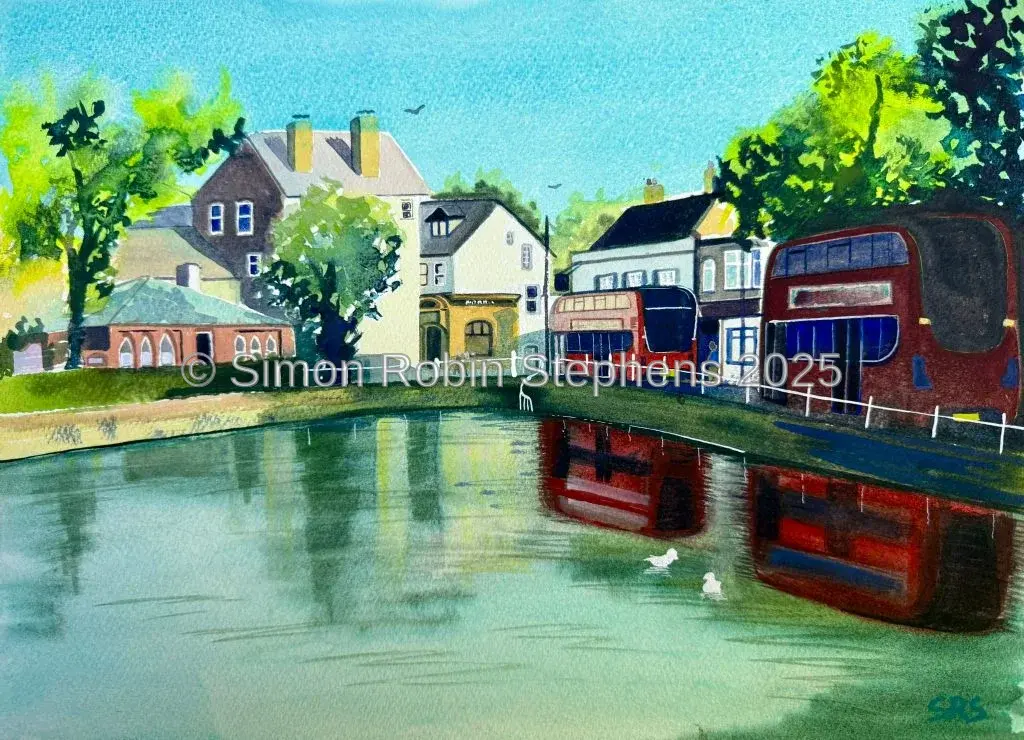
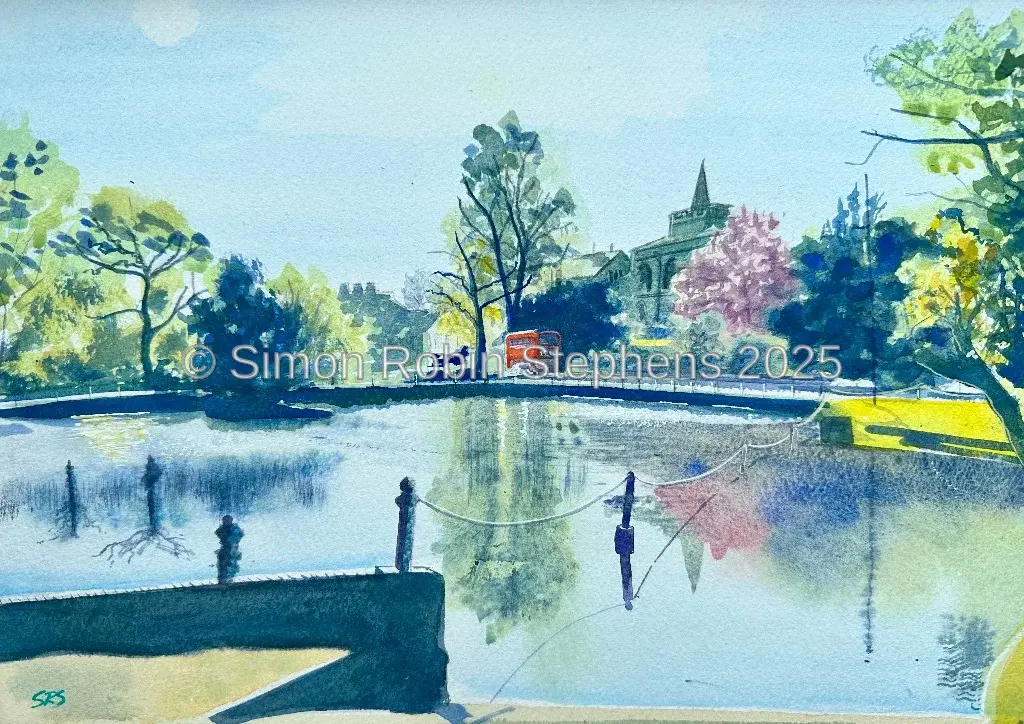
<p>When you paint a location repeatedly, you stop seeing the obvious. The dramatic views fade. What remains are the subtle shifts—how afternoon light hits the water differently in March than September, how the old brick church reflects in the pond at dawn, how resident swans claim different territories through seasons.</p>
<h2>What Makes Carshalton Ponds Historically Significant?</h2>
<p>Carshalton Ponds aren't just pretty water features. They're working history. The ponds formed naturally from chalk springs—the same geological formations that feed the River Wandle.</p>
<p>By the 18th century, the ponds powered local mills and supplied water to grand estates like Carshalton House. The heritage survives: listed buildings surround the water, including All Saints Church (dating to the 12th century) and the Grade II listed Honeywood Museum.</p>
<p>This layered history matters when painting. You're not capturing a generic pond—you're recording a place where people have lived, worked, and found peace for centuries. That depth shows in the work.</p>
<h3>Key Historical Features Around the Ponds</h3> <ul> <li><strong>All Saints Church:</strong> 12th-century church with distinctive tower visible in most pond views</li> <li><strong>Honeywood Museum:</strong> 17th-century Grade II listed building, now a local history museum</li> <li><strong>The Grove:</strong> Historic park and gardens adjoining the upper pond</li> <li><strong>Carshalton House:</strong> 1714 mansion with water gardens designed by Charles Bridgeman</li> </ul>
<h2>How Does Local Heritage Influence Your Art?</h2>
<p>Painting heritage sites requires a different approach than landscape work. You're not just showing what's there—you're acknowledging what's been there.</p>
<p>When I paint the church tower reflection in the lower pond, I'm conscious that this same view has existed for 300 years. The tower hasn't changed. The water hasn't moved. The scene is genuinely timeless.</p>
<p>This permanence creates calm. In a constantly changing city, Carshalton Ponds offer visual continuity. That's why my <a href="https://www.simonrobinstephensart.com/collections/south-london">South London collection</a> focuses on these enduring spots—they ground us.</p>
<blockquote> <p>"The best subjects aren't the most dramatic. They're the ones that let you return, again and again, finding something new in the familiar."</p> </blockquote>
<h2>What Can Painting Teach You About Your Own Neighbourhood?</h2>
<p>Most people walk past Carshalton Ponds daily without really seeing them. The scene becomes wallpaper—noticed but not observed.</p>
<p>Painting forces observation. You must ask: What color is that water? (Not blue—grey-green with bronze undertones.) Where exactly is the light source? (Shifts throughout the day.) How many distinct greens appear in the surrounding trees? (In summer: at least eight.)</p>
<p>This attention transforms how you experience familiar places. You notice seasonal changes. You see patterns. You develop genuine connection with your local environment.</p>
<h2>Why Is Still Water So Effective in Mindful Art?</h2>
<p>Psychologically, water triggers calming responses. Research from Plymouth University's Blue Health initiative found that even images of water reduce cortisol levels and lower heart rates.</p>
<p>Still water amplifies this effect. Unlike crashing waves or rushing rivers, ponds sit quietly. They reflect rather than demand. They invite contemplation.</p>
<p>For <a href="https://www.simonrobinstephensart.com/collections/therapeutic-collection">therapeutic artwork</a>, still water is ideal. It provides visual interest through reflections and light, but maintains overall calm. Therapy rooms, counseling offices, and waiting areas benefit from this balance.</p>
<h3>Psychological Benefits of Water Imagery</h3> <ul> <li><strong>Stress reduction:</strong> Studies show 15-20% decrease in stress markers</li> <li><strong>Improved focus:</strong> Still water provides non-distracting focal points</li> <li><strong>Memory association:</strong> Water scenes often connect to positive personal memories</li> <li><strong>Visual rest:</strong> Horizontal water lines reduce eye strain</li> </ul>
<h2>How Do You Approach Painting Reflections?</h2>
<p>Reflections intimidate many watercolour artists. They seem complex—all those inverted details, the way light fragments on rippled surfaces.</p>
<p>The trick: reflections are always simpler than the object being reflected. They're softer, less detailed, slightly darker. Paint them loosely and they'll read correctly.</p>
<p>At Carshalton Ponds, reflections change constantly. Wind patterns, duck movements, even pedestrians on the bridge alter the water surface. I sketch the overall pattern quickly, then work fast before conditions shift.</p>
<h3>Watercolour Techniques for Reflections</h3> <ul> <li><strong>Wet-on-wet base:</strong> Lay a clean water wash where reflections will appear</li> <li><strong>Vertical strokes:</strong> Pull colors downward to suggest water surface</li> <li><strong>Leave gaps:</strong> White paper creates sparkle and light</li> <li><strong>Soften edges:</strong> Run a damp brush along hard lines to blur them</li> </ul>
<h2>What Makes a Good Subject for Local Heritage Art?</h2>
<p>Not every local landmark translates well to art. You need visual appeal, yes, but also emotional resonance. The site should matter to the community.</p>
<p>Carshalton Ponds work perfectly. Locals visit daily—walking dogs, feeding swans, meeting friends. The ponds are woven into everyday life. When someone from Carshalton sees my paintings, there's instant recognition and connection.</p>
<p>This local specificity matters when creating <a href="https://www.simonrobinstephensart.com/commissions">commissioned artwork</a>. People want art that reflects their place, their memories, their version of the location. Generic landscapes don't carry the same emotional weight.</p>
<h2>How Do You Balance Detail and Softness in Heritage Paintings?</h2>
<p>Heritage architecture demands some precision. If I'm painting All Saints Church, the tower proportions need to be recognizable. Get them wrong and locals notice immediately.</p>
<p>But this is watercolour, not architectural drafting. Too much detail kills the medium's freshness. The solution: sharp focus on one element (usually the main building), then softer treatment everywhere else.</p>
<p>This selective focus mimics how we actually see. Your eye fixates on one thing; peripheral vision stays soft. Paintings that try to sharpen everything look artificial and rigid.</p>
<h2>What Should Collectors Know About Local Heritage Art?</h2>
<p>Local heritage paintings hold different value than generic landscapes. They're personal. Someone who grew up in Carshalton will have emotional investment in these scenes that no amount of technical skill alone can create.</p>
<p>This makes heritage art meaningful for gifts, especially for people who've moved away from an area. A painting of Carshalton Ponds becomes a connection to home, a visual anchor to memory.</p>
<p>All my original South London heritage paintings include historical notes and location details. You're not just buying art—you're preserving a piece of local history.</p>
</section>
<aside class="related-works" role="complementary"> <h2>Related Artworks You Might Love</h2> <ul> <li><a href="https://www.simonrobinstephensart.com/collections/south-london">South London Collection</a> – More heritage locations including Carshalton Grotto and Anne Boleyn's Well</li> <li><a href="https://www.simonrobinstephensart.com/collections/surrey-sanctuaries">Surrey Sanctuaries</a> – Peaceful Surrey locations with historical significance</li> <li><a href="https://www.simonrobinstephensart.com/commissions">Commission Your Local Landmark</a> – I'll paint your favorite South London or Surrey heritage site</li> </ul> <p><em>Free UK delivery over £50. All originals include historical notes and certificates of authenticity.</em></p> </aside>
<section class="faq" itemscope itemtype="https://schema.org/FAQPage"> <h2>Frequently Asked Questions</h2>
<div itemscope itemprop="mainEntity" itemtype="https://schema.org/Question"> <h3 itemprop="name">Can you paint other Carshalton landmarks besides the ponds?</h3> <div itemscope itemprop="acceptedAnswer" itemtype="https://schema.org/Answer"> <p itemprop="text">Absolutely! I've also painted Carshalton Grotto, Anne Boleyn's Well, and the historic Water Tower. If you have a specific Carshalton location in mind, contact me about commissions. I'm local to the area and know it well.</p> </div> </div>
<div itemscope itemprop="mainEntity" itemtype="https://schema.org/Question"> <h3 itemprop="name">Do your South London paintings include historical information?</h3> <div itemscope itemprop="acceptedAnswer" itemtype="https://schema.org/Answer"> <p itemprop="text">Yes. All original paintings in the South London collection include a certificate with historical context about the location, dates, and heritage significance. Prints include abbreviated versions. I research each site thoroughly before painting.</p> </div> </div>
<div itemscope itemprop="mainEntity" itemtype="https://schema.org/Question"> <h3 itemprop="name">Are prints available of the Carshalton Ponds paintings?</h3> <div itemscope itemprop="acceptedAnswer" itemtype="https://schema.org/Answer"> <p itemprop="text">Yes! Prints range from postcards (£3.99) to A2 size (£54.99). All are archival quality on fine art paper with subtle texture. Perfect for Carshalton locals or anyone who loves South London heritage. Free UK delivery over £50.</p> </div> </div>
<div itemscope itemprop="mainEntity" itemtype="https://schema.org/Question"> <h3 itemprop="name">How accurate are your heritage paintings to the actual locations?</h3> <div itemscope itemprop="acceptedAnswer" itemtype="https://schema.org/Answer"> <p itemprop="text">I work from photographs and on-site sketches, so locations are recognizable and proportionally accurate. However, I'm creating art, not documentation—I adjust composition for visual balance and sometimes shift elements slightly for better paintings. The feeling of the place is always authentic.</p> </div> </div>
<div itemscope itemprop="mainEntity" itemtype="https://schema.org/Question">
<h3 itemprop="name">Can you paint a specific view of the ponds I remember?</h3>
<div itemscope itemprop="acceptedAnswer" itemtype="https://schema.org/Answer"> <p itemprop="text">Probably! For commissions, describe the view you remember (which pond, viewing angle, time of day, season). I'll visit the location and sketch options for your approval. Personal memory paintings make wonderful gifts, especially for people who've moved away from the area.</p> </div> </div>
<div itemscope itemprop="mainEntity" itemtype="https://schema.org/Question">
<h3 itemprop="name">Do you sell at local Carshalton art events?</h3>
<div itemscope itemprop="acceptedAnswer" itemtype="https://schema.org/Answer"> <p itemprop="text">Occasionally! I participate in local events when they align with my schedule. Follow my Instagram or sign up for my newsletter to get notifications about upcoming exhibitions, open studio days, and Carshalton-area events. All work is also available online with free local delivery.</p> </div> </div>
</section>
<footer class="article-footer"> <p>Carshalton Ponds will still be here long after I've stopped painting them. That permanence is part of their power. In recording these scenes, I'm joining a centuries-long tradition of people finding peace beside still water.</p> <p>If you have a local landmark that holds meaning for you—in Surrey, South London, or beyond—I'd love to help preserve it in watercolour.</p> <p>— Simon</p> </footer>
</article>
<script type="application/ld+json"> { "@context": "https://schema.org", "@type": "FAQPage", "mainEntity": [ { "@type": "Question",
"name": "Can you paint other Carshalton landmarks besides the ponds?",
"acceptedAnswer": { "@type": "Answer", "text": "Absolutely! I've also painted Carshalton Grotto, Anne Boleyn's Well, and the historic Water Tower. If you have a specific Carshalton location in mind, contact me about commissions. I'm local to the area and know it well." } }, { "@type": "Question",
"name": "Do your South London paintings include historical information?",
"acceptedAnswer": { "@type": "Answer", "text": "Yes. All original paintings in the South London collection include a certificate with historical context about the location, dates, and heritage significance. Prints include abbreviated versions. I research each site thoroughly before painting." } }, { "@type": "Question",
"name": "Are prints available of the Carshalton Ponds paintings?",
"acceptedAnswer": { "@type": "Answer", "text": "Yes! Prints range from postcards (£3.99) to A2 size (£54.99). All are archival quality on fine art paper with subtle texture. Perfect for Carshalton locals or anyone who loves South London heritage. Free UK delivery over £50." } }, { "@type": "Question",
"name": "How accurate are your heritage paintings to the actual locations?",
"acceptedAnswer": { "@type": "Answer", "text": "I work from photographs and on-site sketches, so locations are recognizable and proportionally accurate. However, I'm creating art, not documentation—I adjust composition for visual balance and sometimes shift elements slightly for better paintings. The feeling of the place is always authentic." } }, { "@type": "Question",
"name": "Can you paint a specific view of the ponds I remember?",
"acceptedAnswer": { "@type": "Answer", "text": "Probably! For commissions, describe the view you remember (which pond, viewing angle, time of day, season). I'll visit the location and sketch options for your approval. Personal memory paintings make wonderful gifts, especially for people who've moved away from the area." } }, { "@type": "Question",
"name": "Do you sell at local Carshalton art events?",
"acceptedAnswer": { "@type": "Answer", "text": "Occasionally! I participate in local events when they align with my schedule. Follow my Instagram or sign up for my newsletter to get notifications about upcoming exhibitions, open studio days, and Carshalton-area events. All work is also available online with free local delivery." } } ] } </script>
</body> </html>