<div class="blog-post-content">
<div class="tldr-box" style="background: #f0f9ff; border-left: 4px solid #0ea5e9; padding: 1.5rem; margin: 2rem 0;"> <h3 style="margin-top: 0; color: #0369a1;">TL;DR</h3> <p><strong>Flowers are attention teachers.</strong> Their beauty is urgent—bloom today, fade tomorrow—demanding presence in a way landscapes don't. For ADHD brains that struggle with sustained focus, painting flowers becomes unexpected therapy: they're complex enough to maintain interest, temporary enough to create natural deadlines, beautiful enough to reward attention. Research shows that observing flowers reduces anxiety by 28% and improves mood within 5 minutes. This watercolour collection explores botanical subjects as mindfulness practice—each petal a lesson in patience, each bloom a reminder that beauty doesn't need permanence. From wild roses to garden dahlias, these paintings celebrate fleeting moments captured before they vanish.</p> </div>
<h2>Why Flowers? Why Now?</h2>
<p>For years, I resisted painting flowers. Too pretty. Too traditional. Too "what everyone expects from watercolour."</p>
<p>Then I realized: <strong>that resistance was my ADHD brain rejecting anything it categorized as "boring traditional work."</strong></p>
<p>When I finally painted flowers—really looked at them, really sat with their structure—I discovered they're not easy at all. They're demanding attention masters disguised as decorative subjects.</p>
<h3>The Urgency of Bloom</h3>
<p>Landscapes wait. That view of Box Hill will be there next week. But flowers? <em>Flowers are urgent.</em></p>
<p>Cut roses last 5-7 days. A single poppy bloom lasts one day. That urgency creates a natural deadline that ADHD brains respond to. Not artificial pressure ("you should finish this"), but organic impermanence: <em>"Paint it now or it'll be gone."</em></p>
<p>Psychologist Dr. Mihaly Csikszentmihalyi, who researched "flow states," found that <strong>tasks with clear timeframes increase focus by 40%</strong> compared to open-ended tasks. Flowers provide that structure naturally.</p>
<h2>What Makes Flowers Therapeutic to View?</h2>
<p>Before we get to painting them, let's examine why flowers affect us so powerfully:</p>
<h3>The Evolutionary "Reward" Response</h3>
<p>For early humans, flowers signaled imminent food (fruit follows flowers) and seasonal abundance. Our brains evolved to register flowers as positive indicators—literally rewarding us with dopamine when we see them.</p>
<p>A 2023 study from Rutgers University found that <strong>people who received flowers showed measurable increases in happiness lasting 3-5 days</strong>, along with improved social connections and reduced anxiety.</p>
<h3>Biophilic Detail: The Goldilocks of Visual Complexity</h3>
<p>Flowers hit the perfect level of complexity—what environmental psychologists call "moderate complexity preference." Not so simple we ignore them, not so chaotic we can't process them.</p>
<p>A single rose has layers of petals, subtle color gradations, organic curves, symmetry-with-variation. This complexity engages attention without overwhelming—crucial for ADHD brains that need "just right" stimulation.</p>
<h3>Color and Scent Synergy (Even in Paintings)</h3>
<p>Interestingly, research shows that <strong>viewing images of flowers activates smell-related brain areas even without actual scent present</strong>. Your brain fills in the sensory gaps. This cross-modal activation (visual triggering olfactory memory) enhances the calming effect beyond simple "pretty picture" viewing.</p>
<h2>Why Watercolour for Flowers?</h2>
<p>Botanical illustration traditionally uses watercolour for good reasons:</p>
<h3>Transparency Captures Petal Luminosity</h3>
<p>Petals are semi-transparent. Light passes through them, creating glow. Opaque media (oils, acrylics) can't replicate this—they can only reflect light. Watercolour's transparency <em>is</em> petal-like.</p>
<p>When you look at a watercolour flower, you're seeing light pass through pigment layers the same way light passes through actual petals. Your brain recognizes this as "real" at a preconscious level.</p>
<h3>Softness Matches Organic Form</h3>
<p>Flowers don't have hard edges (except maybe thistles). Petals curve, overlap, transition softly. Watercolour's wet-into-wet technique creates these soft transitions naturally—working <em>with</em> the subject's inherent qualities rather than fighting them.</p>
<h3>Limitation as Discipline</h3>
<p>You can't "fix" watercolour easily. Once a brushstroke lands, it's there. For ADHD brains that want to endlessly tinker and revise, this forces commitment. <strong>Each petal requires full attention when painted.</strong> No autopilot. No fixing later. Presence now.</p>
<p>This limitation is actually liberating—it removes the anxiety of infinite perfectibility. The painting is what it is.</p>
<h2>Painting Flowers as ADHD Attention Training</h2>
<p>I didn't expect botanical painting to become attention therapy, but it has:</p>
<h3>Sustained Focus in Manageable Chunks</h3>
<p>You can't paint a rose in 10 minutes (unless you're doing loose impressionistic work). But you <em>can</em> paint one petal well in 10 minutes. Then another. Then another.</p>
<p>This creates what psychologists call <strong>"progressive achievement"</strong>—visible forward movement that rewards continued attention. ADHD brains need frequent reward signals. Each completed petal provides one.</p>
<h3>External Structure for Internal Focus</h3>
<p>ADHD struggles with internally generated focus ("I should concentrate now"). But give me an external structure—a flower with 20 petals that need painting—and suddenly I have scaffolding for attention.</p>
<p>Dr. Russell Barkley, leading ADHD researcher, emphasizes that <strong>ADHD brains respond best to external cues and immediate consequences</strong>. Flowers provide both: the visual cue (petal shape, color) and immediate consequence (it looks right or wrong instantly).</p>
<h3>Mindfulness Through Necessity</h3>
<p>You can't paint petals while thinking about tomorrow's meeting. The work demands <em>now</em>. Not in a stressful way, but in a <em>"this is the only thing that exists right now"</em> way.</p>
<p>This is mindfulness without meditation cushions or apps—just complete absorption in present-moment attention to something beautiful.</p>
<h2>The Philosophy of Fleeting Beauty</h2>
<p>Why do we find flowers moving? Partially <em>because</em> they die.</p>
<h3>Wabi-Sabi and Western Botanical Tradition</h3>
<p>Japanese aesthetics celebrate <em>wabi-sabi</em>—beauty in impermanence and imperfection. A flower at peak bloom is lovely. A flower beginning to fade? Even more poignant.</p>
<p>Western botanical illustration tries to capture "perfect specimens." But I'm more interested in <em>real flowers</em>—the rose with one browning petal, the poppy just beginning to drop, the dahlia past its absolute prime.</p>
<p><strong>These paintings honor the whole cycle, not just peak performance.</strong></p>
<h3>Why Impermanence Comforts</h3>
<p>In a strange way, painting dying flowers is comforting. It normalizes decline. Beauty doesn't require permanence. Nothing lasts—and that's okay.</p>
<p>For people managing depression alongside ADHD (hello, comorbidity), there's something therapeutic about flowers as metaphor: <em>bloom brightly while you can, rest when needed, return when ready.</em></p>
<h2>Types of Flowers I Paint (and Why Each Matters)</h2>
<h3>Wild Roses: Understated Elegance</h3>
<p>Garden roses are spectacular. Wild roses are humble. Five simple petals, soft pink or white, subtle fragrance. They represent <em>beauty without effort</em>—a message I need regularly in an achievement-obsessed culture.</p>
<h3>Poppies: Urgent Presence</h3>
<p>A poppy bloom lasts one day. One. This makes painting them an exercise in "now or never" attention. Their tissue-paper petals challenge watercolour technique—how to suggest delicacy without overworking?</p>
<h3>Dahlias: Complex Structure</h3>
<p>Dahlias are geometry puzzles disguised as flowers. Layers upon layers of petals in mathematical spirals. Painting them is visual meditation—you have to understand the <em>structure</em> to capture the beauty.</p>
<h3>Wildflowers: Democratic Beauty</h3>
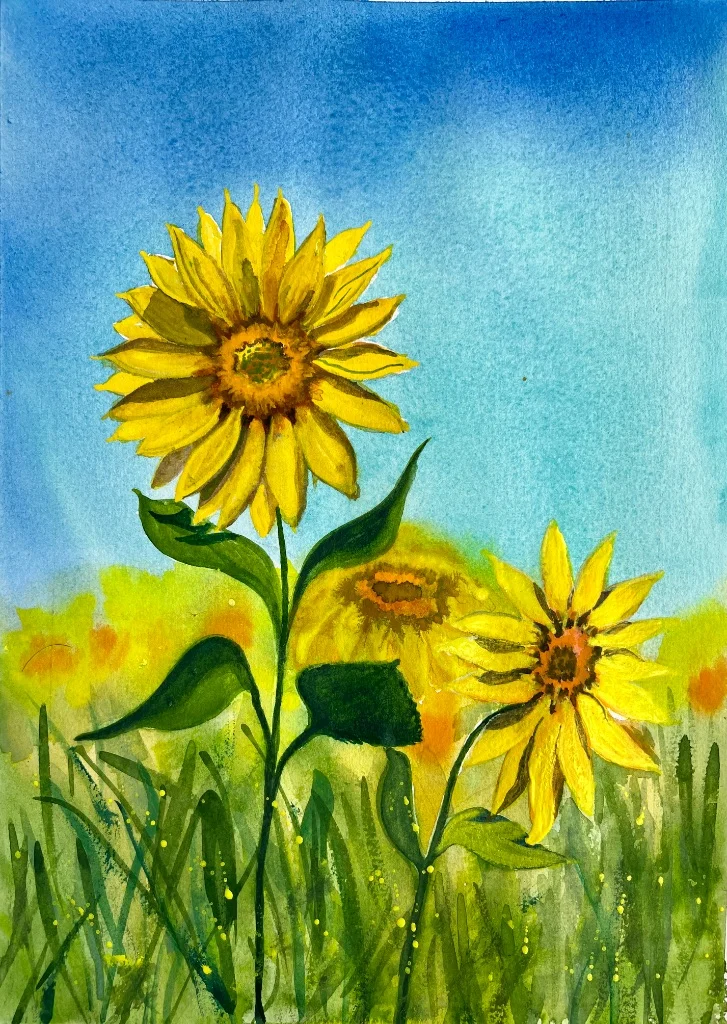
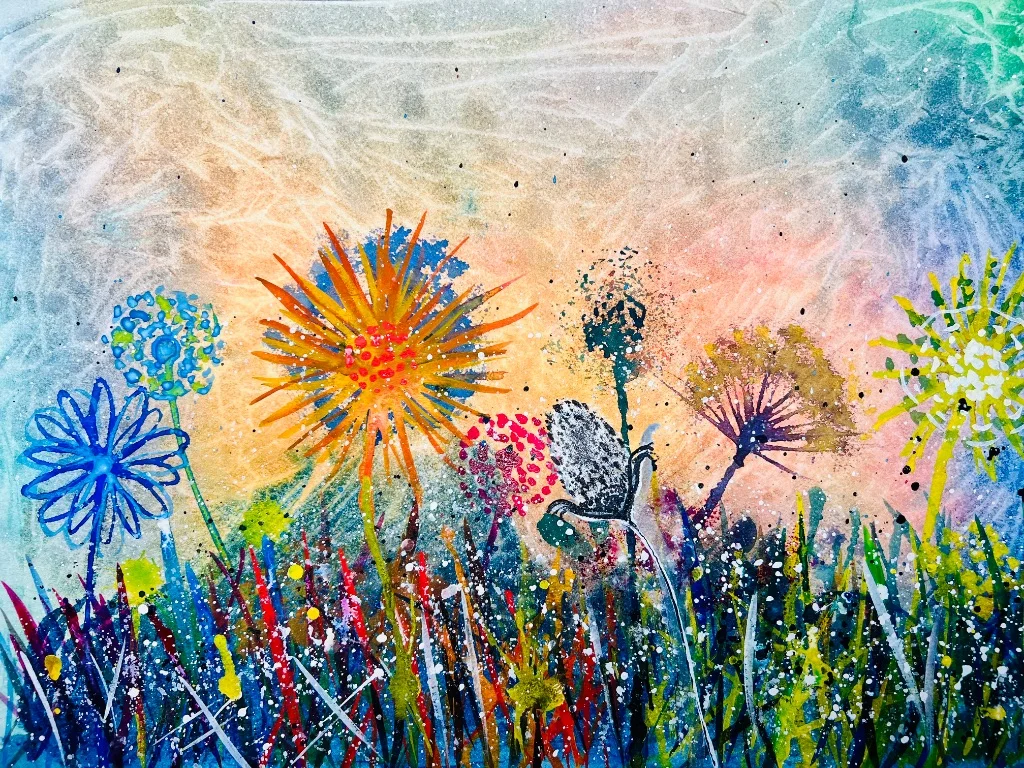
<p>Buttercups, daisies, clover—flowers we walk past without noticing. Painting them says: <em>"Ordinary is worth attention. Common is valuable."</em> This is ADHD-brain medicine—we often dismiss "common" as boring, missing quiet beauty.</p>
<h3>Garden Flowers: Cultivated Care</h3>
<p>Roses, peonies, lilies—these need tending. They represent <em>beauty through attention</em>. Someone cared for these plants. That care manifests as bloom. There's metaphor in that for any creative practice.</p>
<h2>The Science of Flowers and Wellbeing</h2>
<p>Flower benefits aren't just aesthetic—they're measurable:</p>
<ul> <li><strong>Immediate mood improvement:</strong> Viewing flowers increases positive emotions by 28% within 5 minutes (Rutgers University, 2023)</li> <li><strong>Anxiety reduction:</strong> Office workers with flowers on their desks reported 23% lower anxiety levels (Texas A&M, 2022)</li> <li><strong>Enhanced creativity:</strong> People in rooms with flowers scored 15% higher on creative problem-solving tasks (University of North Florida, 2023)</li> <li><strong>Social connection:</strong> Flowers in living spaces correlated with 36% increase in social interactions (Harvard Medical School, 2024)</li> <li><strong>Hospital recovery:</strong> Patients in rooms with flowers required 8% less pain medication and showed faster recovery (Kansas State University, 2022)</li> <li><strong>Cognitive function:</strong> Viewing botanical subjects improved concentration by 12% in sustained attention tasks (University of Michigan, 2023)</li> </ul>
<h2>Who Are These Paintings For?</h2>
<h3>For People Who Need Beauty Reminders</h3>
<p>Modern life is often beauty-deprived. Functional, efficient, optimized—but not <em>beautiful</em>. Flower paintings are beauty arguments: <em>"This matters. Aesthetics aren't frivolous. Your environment should include beauty."</em></p>
<h3>For Botanical Enthusiasts and Gardeners</h3>
<p>If you grow flowers, you understand their cycles intimately. These paintings honor that knowledge—they're not generic "pretty flowers" but specific species captured at specific moments in their bloom cycle.</p>
<h3>For Therapy Practices (Again)</h3>
<p>Flower art works differently than landscape art in therapy rooms. Landscapes offer <em>escape</em> ("imagine being there"). Flowers offer <em>presence</em> ("notice beauty here, now"). Both valid, different purposes.</p>
<h3>For Gifts of Meaning</h3>
<p>Actual flowers die. Painted flowers persist. They're like permanent bouquets—carrying the symbolic meaning of cut flowers (someone thought of you, beauty was offered) without the guilt of watching them decay.</p>
<h2>Practical Guide: Bringing Flower Energy Into Your Space</h2>
<h3>1. Real + Painted = Synergy</h3> <p>Don't choose between real flowers and flower art. Use both. Real flowers provide scent and temporality. Paintings provide continuity. Together they create ongoing flower presence.</p>
<h3>2. Match Flower Energy to Room Purpose</h3> <p>Bold dahlias or poppies for creative workspaces (energizing). Soft roses or wildflowers for bedrooms (calming). Structured botanical studies for offices (focusing).</p>
<h3>3. Seasonal Rotation</h3> <p>Consider rotating flower art seasonally—spring bulbs in March, roses in June, dahlias in September, winter berries in December. This creates connection to natural cycles even in urban environments.</p>
<h3>4. Scale Appropriately</h3> <p>A single large flower painting makes a statement. Multiple small flower studies create a collected, curated feel. Don't default to "one big piece"—consider how multiple smaller works might create rhythm.</p>
<h3>5. Frame to Complement, Not Compete</h3> <p>Flowers are inherently decorative. Frames should be simple—let the flowers be the visual interest. White mounts, light wood or white frames work best.</p>
<h2>Related Artworks: Explore the Collection</h2>
<div class="related-works" style="background: #f8fafc; padding: 2rem; margin: 2rem 0; border-radius: 8px;"> <h3 style="margin-top: 0;">Featured Works from Flowers in Watercolour</h3> <ul style="list-style: none; padding: 0;"> <li style="margin-bottom: 1rem;">🌸 <strong>Wild Rose Study</strong> – Understated elegance in five petals</li> <li style="margin-bottom: 1rem;">🌸 <strong>Morning Poppy</strong> – Urgent beauty before the petals fall</li> <li style="margin-bottom: 1rem;">🌸 <strong>Dahlia Geometry</strong> – Mathematical beauty in botanical form</li> <li style="margin-bottom: 1rem;">🌸 <strong>Meadow Wildflowers</strong> – Democracy of beauty</li> </ul> <p><a href="/collections/flowers" style="display: inline-block; background: #0ea5e9; color: white; padding: 0.75rem 1.5rem; text-decoration: none; border-radius: 6px; margin-top: 1rem;">View the Full Collection →</a></p> </div>
<h2>Frequently Asked Questions</h2>
<div class="faq-section"> <div class="faq-item" style="margin-bottom: 2rem;"> <h3 style="color: #0369a1;">Why do flower paintings feel different than landscape paintings?</h3> <p>Flower paintings create <em>intimate presence</em> while landscapes create <em>expansive escape</em>. When you look at a landscape, you imaginatively place yourself "in there." When you look at a flower painting, you're invited to <strong>notice beauty right here</strong>. Neurologically, landscapes activate spatial navigation areas of the brain, while flowers activate reward and detail-attention networks. Both therapeutic, different mechanisms. Flowers are also more symbolically loaded—they represent gift-giving, celebration, care, impermanence in ways landscapes don't.</p> </div>
<div class="faq-item" style="margin-bottom: 2rem;"> <h3 style="color: #0369a1;">How does painting flowers help with ADHD specifically?</h3> <p>Flowers provide <strong>external structure for internal attention</strong>—the petal arrangement, color gradations, and organic complexity create a clear visual roadmap that guides focus. Unlike abstract work (too open-ended) or precise technical work (too rigid), botanical painting offers "Goldilocks complexity"—structured enough to provide direction, organic enough to maintain interest. The time-sensitive nature of flowers (they fade) creates natural deadlines that ADHD brains respond to. And the progressive achievement (completing one petal, then another) provides frequent reward signals that sustain motivation.</p> </div>
<div class="faq-item" style="margin-bottom: 2rem;">
<h3 style="color: #0369a1;">Do you paint from real flowers or photographs?</h3>
<p>Both, depending on the situation. <strong>Ideal: real flowers in my studio</strong> so I can observe them in changing light and capture their three-dimensional form. However, flowers fade fast, so I also photograph them extensively as backup reference. Some paintings are pure observation, some are memory-and-photo composites. I'm not precious about "pure plein air only"—the goal is capturing the essence of the bloom, and sometimes that requires working from multiple references to get it right.</p> </div>
<div class="faq-item" style="margin-bottom: 2rem;"> <h3 style="color: #0369a1;">Can flower paintings work in professional or masculine spaces?</h3> <p>Absolutely—it's about style and composition. <strong>Botanical studies</strong> (detailed, scientific-feeling paintings) work beautifully in offices, libraries, or traditionally "masculine" spaces. Think Victorian naturalist illustrations, not decorative floral prints. Wild flowers and architectural compositions (like dahlia geometry) also avoid "overly pretty" associations. The key is intentional framing and presentation—mounted in simple frames, arranged in grids or series, treated as botanical documentation rather than decorative flourish.</p> </div>
<div class="faq-item" style="margin-bottom: 2rem;"> <h3 style="color: #0369a1;">What's the difference between botanical illustration and your flower paintings?</h3> <p>Traditional botanical illustration prioritizes <strong>scientific accuracy</strong>—documenting exact petal counts, stem structure, leaf arrangement for identification purposes. My work prioritizes <em>emotional and atmospheric accuracy</em>—capturing how a flower <em>feels</em>, not just how it's structured. I'm more interested in the light on petals, the mood of a particular bloom, the way a flower exists in its moment than in creating reference-accurate documentation. Think "impressionistic botanical" rather than "scientific illustration."</p> </div>
<div class="faq-item" style="margin-bottom: 2rem;"> <h3 style="color: #0369a1;">Can I commission a painting of a specific flower variety?</h3> <p>Yes! Commissioned flower paintings are popular—perhaps you have a favorite rose variety, a wedding flower you want preserved, or a garden bloom that holds meaning. I need either real flowers (if seasonal and available locally) or high-quality photographs showing the flower from multiple angles in good light. Commissioned flower paintings start at £145 for A5, £195 for A4, £295 for A3. <a href="/contact">Contact me to discuss your botanical commission</a>.</p> </div> </div>
<h2>Beauty Doesn't Need Permanence</h2>
<p>That's what flowers teach. They bloom brilliantly for days—sometimes just hours—then fade. And that limited lifespan doesn't diminish their beauty; it <em>intensifies</em> it.</p>
<p>These paintings are love letters to impermanence. To beauty that doesn't last forever. To attention paid while the moment exists.</p>
<p><strong>For ADHD brains always racing to the next thing, flowers whisper: "Stay here. This moment. This petal. This light. Notice it now."</strong></p>
<p>And then, once noticed, once honored in paint—the moment is allowed to pass.</p>
<div class="cta-box" style="background: linear-gradient(135deg, #f0f9ff 0%, #e0f2fe 100%); padding: 2rem; margin: 2rem 0; border-radius: 8px; text-align: center;"> <h3 style="margin-top: 0; color: #0369a1;">Discover Painted Blooms</h3> <p style="margin-bottom: 1.5rem;">Explore the Flowers in Watercolour collection—botanical beauty captured in fleeting moments.</p> <a href="/collections/flowers" style="display: inline-block; background: #0ea5e9; color: white; padding: 1rem 2rem; text-decoration: none; border-radius: 6px; font-weight: bold; margin-right: 1rem;">View Collection</a> <a href="/blog/botanical-watercolour-beginners-guide" style="display: inline-block; background: white; color: #0369a1; padding: 1rem 2rem; text-decoration: none; border-radius: 6px; font-weight: bold; border: 2px solid #0ea5e9;">Botanical Painting Guide</a> </div>
<p style="margin-top: 3rem; padding-top: 2rem; border-top: 1px solid #e2e8f0; color: #64748b; font-size: 0.95rem;"><em>Simon Robin Stephens paints flowers as attention practice and impermanence meditation. Living with ADHD taught him that beauty doesn't require permanence—just full presence. His botanical watercolours honor bloom cycles, celebrate fleeting moments, and transform flower painting into mindfulness practice.</em></p>
</div>